Tuesday, 16 May 2023

Bazaine 1870: Scapegoat for a Nation - Quintin Barry

This review has been submitted to the Journal of the Society for Army Historical Research 

Title: Bazaine 1870: Scapegoat for a Nation
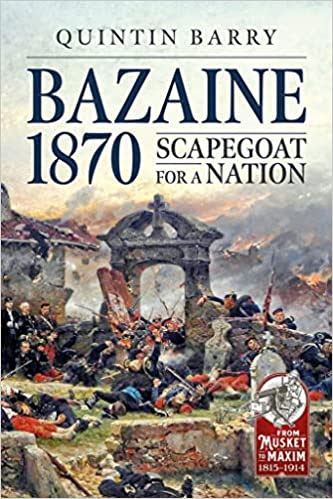
Author: Quintin Barry
ISBN: 978-1-9133-3608-0
Publisher: Helion
Year: 2020
Hardcover
Pages: 308
Photos/Maps: 86/7

"Bazaine 1870" by Quintin Barry is an exceptional historical account that delves into the life and actions of Marshal François Achille Bazaine during the tumultuous year of 1870. Barry's meticulously researched and engagingly written book offers readers a comprehensive examination of Bazaine's role in the Franco-Prussian War and his subsequent surrender of the fortified city of Metz to the Prussian forces.

The book begins by providing readers with a thorough background of Bazaine's early life, military career, and his rise through the ranks of the French Army. Barry deftly sets the stage for the events that would eventually lead to the disastrous Franco-Prussian War. He explores the political and military landscape of the time, discussing the underlying tensions between France and Prussia and the strategic importance of Metz.

What sets Barry's book apart is his ability to present a balanced portrayal of Bazaine. The author does not shy away from showcasing Bazaine's strengths as a military commander, highlighting his tactical brilliance and successes in previous campaigns. However, Barry also critically examines Bazaine's flaws and poor decision-making during the war. He explores the controversies surrounding Bazaine's command, his questionable loyalty, and his controversial decision to retreat to Metz, effectively isolating himself and his army from the rest of France.

Barry's attention to detail is truly commendable. He masterfully captures the essence of the era, vividly describing the battles, the strategies employed by both sides, and the harsh conditions faced by the soldiers. By seamlessly integrating firsthand accounts and primary sources, the author brings the events of 1870 to life, making the reader feel as though they are witnessing the war firsthand.

The book's narrative flows smoothly, guiding readers through the chronology of events with clarity and coherence. Barry expertly balances historical analysis with engaging storytelling, making "Bazaine 1870" accessible to both scholars and general history enthusiasts. The author's clear prose and logical structure ensure that readers never feel overwhelmed by the wealth of information provided.

One of the strengths of "Bazaine 1870" lies in Barry's ability to challenge preconceived notions about Bazaine's actions. The author carefully evaluates the factors that influenced Bazaine's decisions, shedding light on the complexities of his character and the difficult choices he faced. This nuanced approach adds depth to the narrative and invites readers to reconsider their assumptions about this controversial historical figure.

While Bazaine himself is the focus of the authors narrative, the broader internal political machinations of French political and military adversaries undertaking internecine activities against Napoleon III and his government, are woven into the text by Barry to act as the backdrop of this tragic story. The role of Bazaine as pawn within this larger context underscores the bloodsport that represents politics at its most base level and the willingness of those to undertake Real Politique to sacrifice anyone to protect themselves and facilitate their quest for power.

In conclusion, "Bazaine 1870" by Quintin Barry is a remarkable work that offers readers a captivating and insightful examination of Marshal Bazaine and the events of the Franco-Prussian War. Barry's extensive research, balanced analysis, and engaging writing style make this book an essential addition to any history enthusiast's library. Whether one is familiar with this period or encountering it for the first time, "Bazaine 1870" provides a thought-provoking exploration of a pivotal moment in European history. It should also be recognized that the publisher of this work, Helion, has once again produced an outstandingly high quality book.


Friday, 12 May 2023

Legion versus Phalanx: The Epic Struggle for Infantry Supremacy in the Ancient World - Myke Cole

This review has been submitted to Strategy and Tactics Magazine

Title: Legion versus Phalanx: The Epic Struggle for Infantry
Supremacy in the Ancient World
Author: Myke Cole
ISBN: 978-1-4728-2842-2
Publisher: Osprey
Year: 2018
Hardcover
Pages: 288
Photos/Maps: 44/7

Myke Cole's "Legion versus Phalanx" is a captivating and well-researched exploration of ancient warfare, specifically focusing on the clash between two iconic military formations: the Roman legion and the Greek phalanx. In this book, Cole takes readers on a journey through the ancient world, dissecting the strengths, weaknesses, and tactical nuances of these two dominant forces. The book is delineated between setting the doctrinal environment of each style of warfare in the first half, followed in the second, by an analysis of six major engagements where the protagonists each utilized one of the two methods of combat.

The author begins by setting the historical context and explaining the origins and evolution of both the legion and the phalanx. He delves into the cultures and societies that birthed these formations, shedding light on how they shaped military strategies and influenced the outcomes of battles. Cole's deep knowledge and passion for the subject matter are evident in his meticulous attention to detail and his ability to bring these ancient armies to life.

One of the book's notable strengths is its accessibility. Cole strikes a balance between scholarly analysis and engaging storytelling, making the content accessible to both history enthusiasts and casual readers. He avoids excessive jargon and provides clear explanations of key terms and concepts, ensuring that readers can follow along without feeling overwhelmed.

The heart of the book lies in the comparisons drawn between the legion and the phalanx. Cole meticulously dissects their respective structures, training methods, weapons, and tactics. He examines battles such as the Battle of Cynoscephalae and the Battle of Pydna to illustrate how these formations adapted and interacted with each other on the battlefield.

Throughout the book, Cole challenges common misconceptions and provides a fresh perspective on ancient warfare. He dispels the notion that the phalanx was an invincible formation and highlights its vulnerabilities against the more flexible and adaptable legions. Similarly, he showcases the phalanx's strengths, such as its ability to hold a disciplined line and its formidable offensive power when facing less organized foes.

One of the book's highlights is Cole's vivid and engaging writing style. He brings ancient battles to life, describing the chaos, tension, and brutality of the battlefield in vivid detail. Readers can almost hear the clash of shields and the cries of soldiers as they march into combat. Cole's ability to create a palpable sense of urgency and danger is a testament to his skill as a writer.

While the focus of the book is on the clash between the legion and the phalanx, Cole also explores other factors that influenced the outcome of battles, such as leadership, logistics, and terrain. By providing a broader context, he helps readers understand the complex interplay between various elements that shaped the outcome of ancient conflicts.

Overall, Cole does make a strong case for the adaptability and effectiveness of the Roman legion, however, he acknowledges the strengths of the phalanx and offers a balanced analysis of each. "Legion versus Phalanx" is a captivating and insightful examination of ancient warfare. Myke Cole's expertise in military history shines through in his engaging writing style and meticulous research. Whether you are a history enthusiast or simply interested in learning more about ancient warfare, this book is a must-read. It provides a comprehensive understanding of the legion and the phalanx while highlighting the complexities of ancient military strategies.


Tuesday, 9 May 2023

Last Panzer Battles in Hungary Spring 1945 - Norbert Szamveber

This review has been submitted to Iron Cross magazine. 


Title: Last Panzer Battles in Hungary Spring 1945
Author: Norbert Szamveber
ISBN: 978-6-155-58329-2
Publisher: Peko Publishing
Year: 2020
Hardcover
Pages: 487
Photos/Maps: 22/48

"Last Panzer Battles in Hungary" is a gripping and meticulously researched account of the final tank battles fought by German and Hungarian forces against the Soviet juggernaut during World War II. This book delves into the lesser-known theater of war in Hungary, shedding light on the last valiant struggles of the Panzer divisions against the advancing Soviet forces. With its vivid narrative, comprehensive analysis, and insightful commentary, "Last Panzer Battles in Hungary" provides an engrossing portrayal of the desperate battles that unfolded in the waning months of the war.

Szamveber starts by setting the stage, providing essential historical context to understand the significance of the battles that took place in Hungary. He outlines the strategic importance of Hungary as a vital logistical hub and the fierce determination of both sides to control this key territory. The author effectively captures the atmosphere of the time, illustrating the precarious situation faced by the Axis forces and the overwhelming strength of the Soviet Red Army.

One of the book's greatest strengths is its meticulous research and detailed analysis. Szamveber draws on a wide range of primary sources, including firsthand accounts, archival records, and military reports, to construct a comprehensive and accurate narrative. He deftly weaves together the perspectives of commanders, tank crews, infantrymen, and civilians, painting a multifaceted picture of the events and the human toll they exacted. Included in the work are comprehensive Operational tables outlining combat losses, available armoured assets and unit strengths for each of the opposing forces.

The heart of the book lies in its vivid descriptions of the battles themselves. The author skillfully describes the movements of tanks, the ebb and flow of the engagements, and the challenges faced by both sides. The tactical analysis is insightful, offering readers a deeper understanding of the strategies employed and the impact they had on the outcome of each battle. From the desperate efforts to relieve Budapest to the decisive clashes along the Danube River and culminating in the advance on Vienna the author's account provides the readers with a deeply immersive sense of the fighting.

In addition to the military aspects, "Last Panzer Battles in Hungary" excels in portraying the human stories that unfolded amidst the chaos of war. By incorporating personal anecdotes and recollections, Szamveber humanizes the soldiers and civilians involved, allowing readers to empathize with their experiences and sacrifices. The emotional impact of these personal accounts adds depth and resonance to the overall narrative.

The book is enriched by a wealth of maps, photographs, and tables. These visual aids help readers visualize the terrain, troop movements, and the devastating impact of the battles. The inclusion of detailed maps provides clarity, ensuring that readers can follow the events with ease. The visual elements enhance the reading experience and further contribute to the book's overall comprehensiveness.

The author presents a balanced perspective of the conflict, examining the strengths and weaknesses of both sides without bias. The author avoids sensationalism or exaggeration and presents a nuanced view of the fighting. Through this approach, he encourages readers to develop their own understanding of the events while acknowledging the immense challenges faced by the Axis forces as they fought against overwhelming odds.

"Last Panzer Battles in Hungary" is an exceptional work of historical literature that sheds light on a critical but often overlooked chapter of World War II. Norbert Szamveber’s meticulous research, compelling storytelling, and insightful analysis bring the battles to life, capturing both the grandeur and the human tragedy of war. This book is an invaluable resource for military history enthusiasts and anyone seeking a deeper understanding of the final desperate struggles on the Eastern Front.


Monday, 8 May 2023

Blazing Star, Setting Sun: The Guadalcanal-Solomons Campaign November 1942 – March 1943 - Jeffrey R. Cox

This review has been submitted to the Canadian Naval Review.


Title: Blazing Star, Setting Sun: The Guadalcanal-Solomons Campaign November 1942 – March 1943
Author: Jeffrey R. Cox
ISBN: 978-1-4728-4046-2
Publisher: Osprey
Year: 2020
Hardcover
Pages: 512
Photos/Maps: 33/5

"Blazing Star, Setting Sun" by Jeffrey R. Cox is a well-written and thoroughly researched account of the Pacific War from the perspectives of the United States and Japan. The book provides a comprehensive analysis of the military strategies, tactics, and decisions made by both sides during the conflict, as well as their respective political, economic, and cultural contexts. The third book in his series on the Pacific War, he continues to impress with the quality of his research and writing. This book covers the 5 month brutal period of the Battle for Guadalcanal and the Solomon Islands marking a sea change as the West began its inexorable rise and the Japanese their descent in the War of the Pacific.

One of the strengths of the book is Cox's ability to bring to life the individuals who played pivotal roles in the Pacific War. Cox masterfully weaves together the personal stories of key military and political figures, such as Admiral Chester Nimitz, General Douglas MacArthur, Admiral Isoroku Yamamoto, and Prime Minister Hideki Tojo, within the larger historical narrative. Through these personal stories, the reader gains a deeper understanding of the motivations, fears, and aspirations that drove these leaders and shaped their decisions.

The book is also noteworthy for its balanced and nuanced portrayal of both the American and Japanese perspectives. Cox does not shy away from describing the brutality of the war on both sides, nor does he hesitate to critique the mistakes and shortcomings of both the United States and Japan. In doing so, he offers a more complete and complex understanding of the Pacific War that is often lacking in other accounts.

One of the most interesting themes of the book is the role of intelligence in shaping the outcome of the war. Cox highlights the importance of both human intelligence (i.e., spies and informants) and signals intelligence (i.e., intercepted radio messages) in providing critical information that allowed both sides to gain advantages over their opponents. He also demonstrates how the ability to read and interpret intelligence was often the deciding factor in battles and campaigns, such as the Battle of Midway and the Guadalcanal Campaign.

Perhaps the only weakness of the book is its focus on the military and political aspects of the war to the exclusion of other important dimensions, such as the social and cultural impact of the conflict on the people of the United States and Japan. While Cox touches on these issues, they are not given as much attention as they could have been. However, this is a minor criticism given the scope and depth of the book.

Overall, "Blazing Star, Setting Sun" is an outstanding account of the Pacific War that will appeal to anyone interested in military history, international relations, or the human experience of war. Cox's prose is clear and engaging, and his analysis is insightful and thought-provoking. This book is a must-read for anyone seeking a deeper understanding of the Pacific War and its lasting impact on the world.


Selling Schweinfurt: Targeting, Assessment, and Marketing in the Air Campaign Against German Industry - Brian D Vlaun

This review has been submitted to the RCAF Journal.


Title: Selling Schweinfurt: Targeting, Assessment, and Marketing in the Air Campaign Against German Industry
Author: Brian D Vlaun
ISBN: 978-1-682-47536-2
Publisher: Naval Institute Press
Year: 2020
Hardcover
Pages: 303
Photos/Maps: 15/0

In his book "Selling Schweinfurt: Targeting, Assessment, and Marketing in the Air Campaign against German Industry," author Brian D. Vlaun examines the complex process of target selection and assessment in the Allied air campaign against German industry during World War II. Vlaun draws on a wide range of sources, including official government records, personal papers, and contemporary media reports, to provide a detailed account of how the Allied air forces identified and prioritized targets for bombing.

The book is divided into three main parts. In the first part, Vlaun provides an overview of the Allied air campaign against German industry, emphasizing the strategic importance of targeting key industrial centers. He discusses the challenges faced by the Allies in terms of target selection, including the difficulty of accurately assessing the effectiveness of bombing raids and the need to balance strategic objectives with operational realities.

In the second part of the book, Vlaun delves into the system of target selection and assessment. He describes the various methods used by the Allies to identify potential targets, including aerial reconnaissance, intelligence gathering, and analysis of German industry's organizational structure. He also examines the complex process of prioritizing targets based on their strategic value and vulnerability.

One of the most interesting aspects of Vlaun's analysis is his discussion of the role of marketing in the Allied air campaign. He argues that the Allies relied heavily on propaganda and psychological operations to sell their bombing campaign to the public, both at home and abroad. For example, the famous "bomber boys" of the US Eighth Air Force were promoted as heroes and symbols of American determination to defeat the Nazi regime. Vlaun suggests that this kind of marketing played an important role in sustaining public support for the bombing campaign, even in the face of mounting casualties and criticism.

In the final part of the book, Vlaun assesses the effectiveness of the Allied air campaign against German industry. He argues that while the bombing campaign did have a significant impact on the German war economy, its overall strategic value has been overstated. Vlaun notes that the Allied air forces failed to achieve their primary objective of crippling German industry, due in part to the resilience and adaptability of the German war machine. Additionally, he makes the argument that the “behind the scenes” political machinations surrounding the relevance and effectiveness of the air campaign and, by extension, the maintenance of a separate Air Force, was a driving factor in ensuring that the 8th Air Force conclusively demonstrate that it was able to decisively impact the Germans ability to continue prosecuting the war. Vlaun also undertakes an insightful analysis of a US intelligence community that was created only as the air war intensified in 1942-43 and thus has little to no operational experience from which to develop its processes and doctrine.

The results of a very junior service striving to justify itself while concurrently validating an air campaign replete with political undercurrents, was that the Air Force intelligence community was highly motivated to produce assessments that justified the operational effort and supported the strategic focus on ball-bearing and oil production facilities as a means of hamstringing the German military industrial complex. This, despite the fact, that there was little to practically show in the way of a tangible negative impact upon the German industrial sector.

Overall, "Selling Schweinfurt" is a well-written and thoroughly researched book that provides a fascinating insight into the complexities of target selection and assessment in the context of the Allied air campaign against German industry. Vlaun's analysis is nuanced and insightful, and he does an excellent job of balancing the strategic and operational aspects of the bombing campaign with the human and ethical implications of aerial warfare.

"Selling Schweinfurt" is an superb addition to the growing body of literature on the Allied air campaign against Germany during World War II. It is an important reminder of the complexity and human cost of aerial warfare, and a valuable resource for anyone interested in the history of military strategy and tactics. It also serves as an outstanding case study of the impact of outside influences and internal assumptions on the quality of product that an organization might produce.


Wednesday, 22 February 2023

Flesh and Steel During the Great War - Michel Goya

This review has been submitted to the Journal of the Society for Army Historical Research

Title: Flesh and Steel During the Great War
Author: Michel Goya
ISBN: 978-1-473-88696-4
Publisher: Pen-and -Sword
Year: 2018
Hardcover
Pages: 323
Photos/Maps: 17/5

Warfare, on the surface, personifies the best and worst of humankind: ultimate selfless sacrifice and unspeakable brutality. However, one of the benefits of large-scale conflict, is a laser focus by the governments of the warring nations upon developing any advantage that will enable them to prevail against their adversaries. This manifests itself as enormous advances in science, medicine, and technology, free of the financial and bureaucratic frictions that exist in peacetime. Michel Goya’s book undertakes a detailed analysis of the state of the French Army leading up to the commencement of hostilities in 1914, focusing upon the political and interpersonal challenges to modernization. He then traces the advances in the French military (to include the nascent Air Force and the three main combat arms elements) as the crucible of war and experience strip away the impediments that traditionally hamstrung its development. He incorporates into this discussion the changes in the mentality of the Chain of Command and the decision-making processes to highlight how new critical paths to change were generated. Finally, he closes his work with an overview of the state of the military at the close of the War and what transpired in the years following.

The experiences of the French front line soldier provide the context within which innovation is discussed. Drawing upon real life examples, Goya is able to provide tangible examples of the dynamic realignment in the decision making and doctrinal development process. Thus it was that the traditional top-down, centralized process of operational doctrine, invalidated by the shocking, near run failures of 1914 and the inability to break the stalemate of the following years, is supplanted by local, coal-face, innovation derived from real time engagement with the enemy. Goya explores in great detail how this transition occurred, what were the driving motivators that adjusted the French Command paradigm, and the impact that it had on operations.

 For the reader, understanding how the various elements adapted to the increasingly technological and complex face of the conflict is key towards appreciating just how dramatic and dynamic was the metamorphosis of the French military. Not only were these changes felt in the traditional fields of combat, but commanders and planners had to incorporate utterly new capabilities spanning the fields of communications, aviation and armour into effective joint operational and doctrinal use. The author presents the scope and pace of these complex changes in a lucid, insightful manner; laid out in a logical and easily understood style. Goya also expands upon the ongoing internal debates on how best to utilize these new capabilities; politics within the French military were never far from the surface and the authors discussion on how these manifested themselves makes for fascinating reading.

 Peacetime change within a military context is a slow, bureaucratic and pedantic process that may take years to realize change; wartime drives change through necessity and emphasis. The author has captured both sides of the French military experience in his book and, in the process, sheds light on the myriad of challenges that are unique to both circumstances. His extensive bibliography, notes sections and detailed appendices provide a breadth of context and additional sources for the reader to take advantage of. Of particular note is his comprehensive analysis of the experiences of the 13th Infantry Division, a unit that was present from the first to the last day of the war. This analysis adds depth and an additional definitive example for the reader to grasp the authors intent of the book.

This is an excellent work of military history; touching upon a relatively little known or appreciated aspect of warfare: dynamic change. It is very strongly recommended for the professional and casual historian alike.

Saturday, 4 February 2023

The 7th Guards Army form Kursk to Prague 1943-1945 - Dann Falk


 This review has been submitted to Iron Cross magazine.

Title: The 7th Guards Army form Kursk to Prague 1943-1945
Author: Dann Falk
ISBN: 978-1-732-60742-2
Publisher: Falken Books
Year: 2022
Softcover
Pages: 547
Photos/Maps: 56/77 

Much has been written at the macro-level about operations on the Eastern Front during WW2. Dann Falk has uniquely decided to focus his efforts on the operational history of the 7th Guards Army (formally the 64th Army) and, in this second installment, traces its activities from Stalingrad to the end of the war in Prague. Due to its stellar performance in defence of the southern region around Stalingrad, it was one of only 11 Infantry Armies and 5 Tank Armies that would receive the Guards designation from Stalin throughout the war. 

Falk’s approach to writing entails a daily synopsis of the activities of the Combined Arms Infantry Army, challenges that it faced and the efforts of the Germans on those days to counter the Soviet maneuvers. Thus it is that each day provides a unique snapshot of the Eastern Front within an ongoing narrative. Falk’s research is phenomenal and the level of detail both in terms of personnel and equipment as well as activities is noteworthy. In addition, he weaves accounts of specific elements of the adversaries (such as logistics, women in combat, operational environments and personal anecdotal narrative) that add depth and complexity to the account. 

Particular consideration needs to be paid to the high quality of the charts and maps provided by the author as references to the narrative; each was drawn and drafted by the author. Thus, unlike many histories of the region that use original German or Soviet maps that, while interesting, are, in many cases, of limited value due to their language and complexity, the maps provided by Falk are clear, easy to follow and provide excellent references to actions within the storyline. The charts that he developed present an excellent synopsis of different aspects of the book being discussed; particularly those of the conclusion at the end of the book that provide first-rate summaries of pan war achievements of the 7th Army as well as available Soviet forces for ongoing operations should that have been necessary. 

Falk has drafted a brilliant, yet highly readable, account of the exploits of this superb fighting Army. His attention to detail is impressive and his research comprehensive; however, these aspects of the book do not prevent the reader from appreciating the full spectrum of experiences associated with the complexity of operations on the eastern Front. His anecdotal style and operational assessments serve to highlight the continuing professional development of the Army in terms of joint competency as the War progressed. The author does not hesitate to present an unvarnished account, at the personal level, of the humour, tragedy, and brutality of the conflict from both the German and Soviet perspectives with a strong emphasis on the latter. This work is a nuanced and very balanced assessment of the Soviet forces covering the spectrum of operational and logistical support elements in equal measure. 

The quality of the publication is excellent, the font easy to read and the layout of the book clear and concise. Falk has provided an extremely comprehensive bibliography that gives the reader the opportunity to follow up through a myriad of primary and secondary sources. This book is an outstanding source for those who are either serious WW2 bibliophiles or casual historians.