Showing posts with label Historical Fiction. Show all posts

Tuesday, 18 September 2018

Breakout At Stalingrad - Heinrich Gerlach

This review has been submitted to British Army Review.

Title: Breakout At Stalingrad
Author: Heinrich Gerlach
ISBN: 978-1-7866-9062-3
Publisher: Apollo
Year: 2018
Hardcover
Pages: 707

The story behind the writing and publication of this novel is in fact a story unto itself. The author, Heinrich Gerlach, was a German soldier captured after the surrender of Stalingrad in February, 1943. He remained in Soviet captivity until 1950. During that time he gathered the stories of a number of fellow Stalingrad survivors including some of the most senior ranking officers. He then drafted his 600 page manuscript in secret between 1943-1945 while in captivity. The novel is not an autobiography but he is represented in the book as Lt Breuer, an Intelligence Officer with an armoured unit.

Gerlach wrote this book as a testament to the German Landser (soldier) and their experiences in the Stalingrad pocket. It is an intimate and raw narrative. Every aspect of their lives and trials is articulated through the books characters. This is not about strategy, tactics or the good or bad elements of the war; it is a story about men trapped in a tightening noose and their reactions to that environment. He is able to accurately relate, to those who may only appreciate the reflection of the horrors of Stalingrad, the agony of the 6th Army as it gradually but inexorably deteriorated from a professional fighting force into a starving mob, scrabbling for survival. Gerlach is able to relate the best and worst of the human condition, stressed beyond imagination.

The author drafted his manuscript as a means of dealing with the nightmare that he and hundreds of thousands of his comrades had endured; that he was able to undertake this task so soon after the event further enhances the poignancy of the account. While the characters may be amalgamations of numerous people, the environment is accurate and horrific.

The story itself follows a section of soldiers, each with their own perspective on the war and the Nazi regime. Each character is well developed within the context of the Stalingrad environs and the struggle each has internally and externally; as the battle unfolds and becomes more desperate, this struggle is both realistic and thought provoking. The reader can easily find themselves psychologically embedded with the characters in the book.

This was fascinating book to read, coming from an author who personally experienced the narrative he created. It flows well and it is easy to lose track of time as one becomes drawn into the story. The addition of the addendum explaining the background of the novel and its transition from Soviet hands back into German in 2011 is very unique. This is a strong story with an affecting narrative that reminds one of Guy Sajer’s: The Forgotten Soldier. It is well worth an in-depth read.

Monday, 10 October 2016

Ostland - David Thomas

Title: Ostland
Author: David Thomas
ISBN: 978-162-3-65849-6
Publisher: Quercus
Year: 2015
Hardcover
Pages: 400

David Thomas’s novel is an in-depth psychological analysis of how an individual is able to be manipulated and, by extension, enable themselves to be manipulated thereby adjusting their moral compass in a justifiable manner. It is a study of transformation facilitated by duty, circumstance, training and conditioning.

Commencing in pre-war Germany, the author traces the career of a brilliant young police detective as he commences his profession with one of the elite crime squad units in Berlin. What starts as an idealistic, somewhat naïve approach to the harsh realities of police work undergoes a gradual but inexorable change as his success results in promotion and additional responsibilities concurrent with the rise of Nazism and the outbreak of war. This entails a commission in the SS, a transfer to Minsk and an expanding task of dealing with partisans and other undesirables (namely Jews). The narrative flips between the pre-war and war period to the early 1960’s when another idealist undertakes the prosecution of one of West Germany’s greatest police officers for war crimes (the self-same young police detective).

The author has created a fascinating and disturbing analysis of human nature and its strength and vulnerability. Looked at with the benefit of hindsight it is easy to condemn in the strongest terms and with broad strokes the behaviours of those responsible for the slaughter of so many. Yet, examined in greater detail it becomes apparent that the activities of these individuals may in fact be far more nuanced than the black and white that society wishes.


This book is not an apology or an excuse for the appalling activities of the SS, Gestapo and the police forces who carried out the policies of the WW2 German government but neither is it a blanket condemnation. Like all great books, the author sets out to force the readers, through the medium of a story, to challenge paradigms, cause to reflect and to think. Thomas succeeds in this endeavour extremely well.  His story telling is factual and tight, the pace, while not dynamic is nonetheless engaging. This is a well written, disturbing narrative of a cast of characters and their society in a struggle that transcends the sounds of the guns and strikes at the very nature of who we are and how we deal with unimaginable circumstances. 

Monday, 9 March 2015

Devil's Guard - George Robert Elford

Title: Devil's Guard
Author: George Robert Elford
ISBN: 978-0-440-12014-8
Publisher: Dell Publishing
Softcover
Pages: 336
Photos/Maps: 0

Elford's book has become, in the opinion of many, a classic biography of a soldier engaged in asymmetric warfare. The main character, ex-Waffen SS partisanjaeger Hans Josef Wagemueller, is pro-ported to have met with the author in the far east and to have related his life story to him. The author recounts his tale, with as little change or embellishment as possible, of him leading his German troops west during the last days of the World War 2, escaping to Switzerland and ultimately joining the French Foreign Legion. The main thrust of the narrative centres upon his time with the Legion fighting in Indochina against the Viet Cong as part of an all-German battalion of veterans and his experiences there-in.

The story has generated a great deal of controversy over the years as there is no record of an all-German battalion nor of an individual named Wagemueller ever having fought as part of the Legion. Regardless of whether the story is truth or fiction really is however, beside the point as the lessons to be gleaned from it resonate either way.

Given the experiences that Western forces have had in Afghanistan and Iraq fighting asymmetric opponents, the question of what constitutes acceptable methods of executing a war has again become a central point of discussion and contention. Wagemueller's character in the book takes the position that war is, by its very nature, violent and horrible, but must be fought to win and, in order to do so, the conditions must be established and maintained whereby the side wishing to prevail does what it must to enforce its will upon the population and the enemy. It is a testament for the Real Politique approach to conflict.

Additionally, Elford's narrative translates doctrine into action as he describes through the storyline the how, what, where and why's of a unit doing what it has to in order to win. Wagemueller's character is uncompromising in his rendition of the toll that fighting to win takes upon all of the elements of society involved and, more importantly, the mental strength that soldiers must have in order to do what they have to do. Finally, and perhaps most telling, Wagemueller describes the methods by which his unit was recalled and disbanded as a result of a lack of support from the French government and population. The similarity to the impact of popular opinion on modern warfare is striking.

The story itself reads very well and is extremely engaging; the characters are presented with a human face, not enjoying what they are doing but undertaking it regardless. It is not a comfortable read and will tend to polarize its readers between those agreeing with and those appalled by the actions of the main characters. Its strength, I believe, lies in the fact that it was first published in the early 1970's during the height of the Vietnam conflict and yet, it still retains its relevance today as a means to stimulate healthy debate and discussion amongst military professionals and their leaders.

Wednesday, 1 October 2014

The Coming of the Dawn - A.K. Silk


Title: The Coming of the Dawn
Author: A.K. Silk
ISBN: 978-1-927-53335-2
Softcover
Pages: 246

This book represents the author's first foray into the world of fiction. A lifelong passion for history and the centenary of the beginning of the First World War has led to his drafting of this novel of squadron life and death in 1918. His story focusses upon Patrick Dyson, a 2Lt transferring from the infantry into the Royal Flying Corps, as he struggles with the morality of combat, post traumatic stress (known then as shell shock), personal loss and the day to day interactions with his fellow squadron mates. 

Fiction serves as an excellent medium for the passage of lessons and the investigation of the human condition in times of extreme dislocation and stress. The author is able to create for the reader the atmosphere of the environment and experience required to convey the what, why and how of what would be, for the vast majority of us, circumstances that may only be understood in the abstract.

Silk has done a commendable job at creating a storyline that maintains pace and tension. The reader appreciates the struggle that Dyson and his fellow aircrew endure as they grapple with the daily terror of not only combat (and the prospect of burning to death or horrible injury) but also the potential of being viewed as a coward and ostracized by their peers and countrymen should they not meet the criteria of conduct expected by their comrades.

Silk's narrative reveals a deep period knowledge that shows that he has done his research about his subject, thereby adding both a depth of realism to his storyline and education for his readers. I was particularly struck by his description of Dyson's struggles with his own fear of combat and failure as he endures his introduction to aerial combat. One comes away appreciating what it took for these young men to undertake their missions in the full knowledge of what potentially lay ahead for them. 

Without a doubt. a strength in any novel is the ability of the author to surprise the reader with plot twists and turns. The Coming of the Dawn does not disappoint in this regard as Silk ensures a number of concurrent story lines intersect such that they keep the reader guessing. Aerial combat is interwoven with the apparent contradiction of social interaction with the enemy and the critical need for acceptance of the combatants by their peers.

This is a book worth reading. It represents a solid and worthy introduction of Silk into the genre of aerial fiction. For those who have enjoyed Spencer Dunmore and Derek Robinson as authors, Silk will not disappoint.  


Saturday, 31 May 2014

Into The Gates of Hell: Stug Command '41 - Bob Carruthers and Sinclair McLay

Title: Into The Gates of Hell: Stug Command '41
Author: Bob Carruthers and Sinclair McLay
ISBN: 978-1-7834-6242-1
Softcover
Pages: 313
Photos: 0
Publisher: Pen and Sword Publishing

This book is the second in a series of books based upon notes and manuscripts drafted by an un-named German officer under the pen-name Ritter von Krauss of his experiences during the First and Second World War. His works, written, it is believed, between 1954 and 1968, were released to the authors with the strict stipulation that his family name never be revealed and that none of the works be published while his immediate children were still alive. The manuscripts themselves have been verified as genuine and, while little is factually known about von Krauss, it is believed that he came from a wealthy aristocratic family reduced to poverty in the 1920's. A firm believer in National Socialism, he is felt not to have harboured any anti-semitic views but rather saw the movement and Hitler as a way to reunify and strengthen Germany. It is also believed that he served as an armoured officer in both world wars. 

Carruthers and McLay have created an enjoyable read out of the strawman manuscript that they received. The story centres around the German assault on the Fortress of Brest-Litovsk during the opening days of Operation Barbarossa (the German attack on the Soviet Union in 1941). The plot is not terribly complicated but it does impart a great deal of information regarding the various types of equipment in use, tactics of the day, weapons capabilities and historical context. The characterization is rather two dimensional as the Germans, for the most part, are painted in a civilized yet negative and barbaric light in their actions, while the Russians themselves are portrayed as less sophisticated but determined and sympathetic. I felt that this was rather shallow and perhaps a little too stereotypical. Overall, the storyline felt very dense with, I felt, too many lines of approach; it all felt a mile wide but an inch deep.

Nevertheless, the authors do bring to light individuals who played key roles in the defence and assault of Brest Litovsk whose names have subsequently been lost to all but the most ardent of historians. Without the key intervention and initiative of Commissar Fomin and Captain Zubachyov, the battle for the fortress would have been much shorter and easier for the Germans. As it was, their example served to energize the defence and resulted in a bloody fight lasting for weeks instead of hours; as much as possible, the authors have utilized actual participants within their rendition of the battle.

I would have enjoyed having a map of the fortress and a regional map to cross reference against the narrative. This would have provided a much better appreciation of the nature of the fighting. Also, it would have been helpful if the authors had provided historical footnotes to further enhance the storyline by adding additional actual information in a similar way that Peter Tsouras or George McDonald Fraser do in their works of historical fiction.

This work was an enjoyable read and I did find it to be both entertaining and educational. Certainly, there is room for improvement but I still believe that it is worth perusing. Historical fiction is a very difficult genre within which to work and the authors have written a worthy addition to that body.


Monday, 23 September 2013

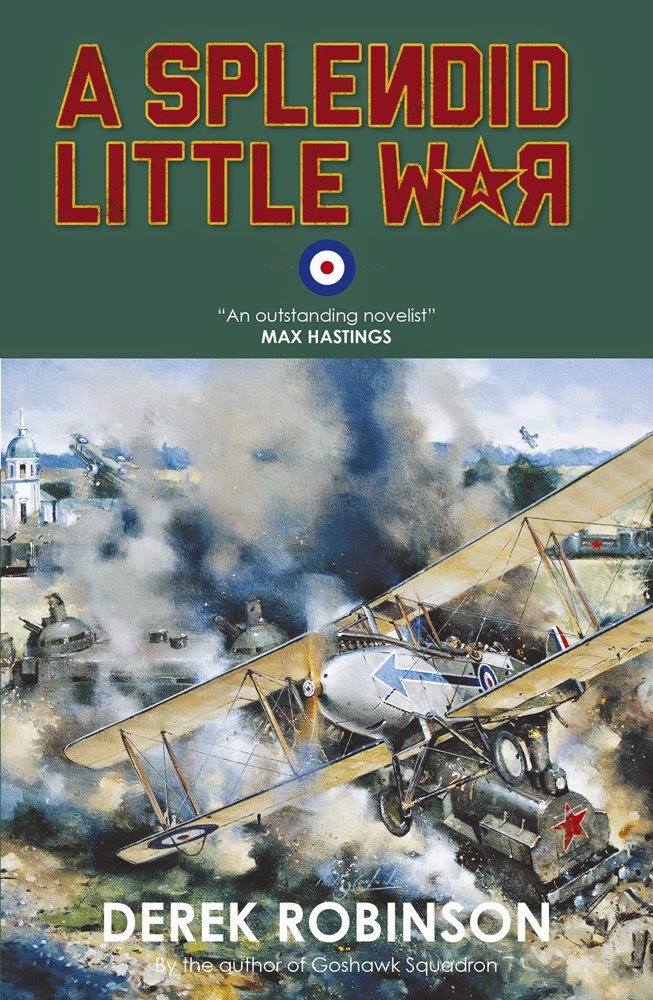
A Splendid Little War - Derek Robinson


The information presented was written by Chris Buckham; however, it was published in Soldier Magazine. Therefore, the material is reproduced here by the author with the permission of the magazine. If you would like to republish this information or refer to excerpts please contact the Assistant Editor Soldier Magazine (rclark@soldiermagazine.co.uk). Website for the Magazine is: http://www.army.mod.uk/soldier-magazine/soldier-magazine.aspx


Title: A Splendid Little War 
Author: Derek Robinson
Publisher: Quercus Publishing
ISBN: 9780857052322
Date: 2013
Pages: 316
Rating: 5/5

Mr Robinson has once again exceeded (already high) expectations and has produced another novel replete with tragi-comedy, education, cynical humour and action. Set in the midst of the Russian civil war, the book follows the experiences of Merlin Squadron, the RAF fighters sent to support the White Russian army in the southern steppe. Robinson is master of character development and he is able to capture the essence of the post war British Officer sent on yet another international escapade. A tight storyline woven into a historically accurate rendition of the conditions and folly under which the British airmen operated; this book cannot be recommended highly enough.

Monday, 20 May 2013

Damned Good Show - Derek Robinson

Title: Damned Good Show 
Author: Derek Robinson
Softcover
Pages: 316
Publisher: Whistle Books, 2009


              Robinson has presented us with another work in his World War 2 British aviation series. Each of his books may stand alone but are also interwoven with the others; characters are found overlapping between the novels. All are outstandingly readable, educating and entertaining.
 
              In the case of Damned Good Show, Robinson focuses upon 409 Squadron, a bomber unit flying Hampdens (an early war period two engine long range bomber). The period in question runs from the early days of the war in 1939 through to early 1942. The unit is highly motivated and full of characters that, as with all of his books, grow as the book progresses. The author knows his subject extremely well both from a technical and psychological perspective. Thus, as the hardships and horrors of war gradually emerge from the early halcyon days of what the Germans called Sitzkrieg (sitting war), the reader can follow as the characters begin to experience the shortfalls of their equipment, doctrine and preparation.
 
              Unique amongst the authors of books of this nature that I have read, Robinson is able to pass onto the reader a sense of the impact that war had upon the tightknit community that was a pre-war bomber squadron in the RAF. Without giving away the plot, the reader experiences the wrenching and sudden confusion and loss as characters disappear from the narrative. One becomes reluctant to form an association, however transient, with a character as you do not realize how long they will be a part of the text. It is unusual and dislocating for the reader which is exactly the impact that Robinson wished to convey.
 
              All is not gloom and doom. Robinson skillfully weaves into the storyline the efforts of the British propaganda machine to maintain morale during the dark days of the Blitz and the fall of France. Thus the reader is carried along as the challenge of what constitutes truth in war is debated and argued from the perspective of idealistic film makers and “reale politique” government agencies who realize that truth is perception and not necessarily reality. Caught in between is the 409 Sqn; representative of the only arm of the British military to be carrying the fight to the enemy during this period. Film makers, imbedded within the unit struggle trying to capture a true sense of what happens during an operation while, at the same time, creating a film that will meet the needs of the audience.
 
              Robinson engages the reader and makes them think. His caustic, black humour and the cynical outlook of his characters capture the essence of those trying to make sense out of the insanity around them. Of course, finding that they cannot, they find solace and comfort where they can, when they can and with whom they can. It is the nature of war.
 
              Robinson is a master of his trade and his work holds lessons for all who are astute enough to see them. He entertains and he educates and one cannot ask for more than that. Well done.

Sunday, 28 April 2013

Tank: 40 hours of battle, August 1944 - Ken Tout


Title: Tank: 40 Hours of Battle, August 1944 
Author: Ken Tout
Pages: 208
ISBN: 0709055838
Publisher: Robert Hale

Ken Tout has written a poignant and moving book about the psychological and physical challenges of tank combat during the Second World War. His book is set in Normandy shortly after the invasion and is focused on the experiences on one crew during a period of 40 hrs of intense operations and combat against a determined and experienced adversary. While it is historical fiction, it represents an amalgam of the soldiers and comrades that Tout served with during his time as a tanker in the 1st Northamptonshire Yeomanry.

Tout’s writing style is direct and compassionate. One is drawn into the characters and the sense of ‘being there’ is quite profound. The reader is exposed to the emotional trauma of fighting within the hedgerows of the Normandy countryside, to the stress of waiting for combat, of the drama listening to one’s peers engage and burn and of having to recover their remains. Of particular note is the appreciation one begins to feel of the physical and psychological exhaustion of maintaining constant vigilance in the close confines of a Sherman tank desperately trying to see the enemy before he sees you.

Tout is a magnificent writer in the same class as Guy Sajer (The Forgotten Soldier). He has a profound gift for giving life and depth to his characters. His narrative underscores the coping mechanisms that soldiers everywhere fall back on to overcome the sheer terror and monotony of war; the black humour, intense comradeship and the drawing upon the strength of others to augment when your courage may be flagging. Indeed, Tout’s characters are intensely human, vulnerable and average by the standards of their peers in similar situations but are seen to overcome unimaginable conditions when held up against those who have never experienced combat.

What I also enjoyed about the book was the way in which the reader is given an appreciation of what it takes to run, manage and maintain a tank in operations. Notwithstanding the mental stress of the job, the physical demands are incredible: loading, engine maintenance, track changing and general maintenance on the tank is simply hard and grinding work. Also, the crews personal needs such as eating, sleeping and going to the bathroom require coordination and unique approaches, skills developed only by men in combat.

Tout speaks of the Sherman tank in the language of the tankers that crewed and fought them. A ‘Ronson’ was a famous lighter company of the period and, as the Sherman was gasoline driven as opposed to the German diesel, it had a tendency to burn quickly and intensely thus giving the crew little time to evacuate. Therefore, in the gallows humour of soldiers universally, a burning Sherman was known as a Ronson.

Tout’s book represents a vivid recreation of the life within a Sherman tank during operations in the Normandy countryside. He has a remarkable ability to engage the reader and provide insight into the human condition in an insane environment. This book should be mandatory reading for any aspiring soldier or leader. I highly recommend it. 

Thursday, 18 April 2013

Rome The Art Of War - MC Scott


The information presented was written by Chris Buckham; however, it was published in Soldier Magazine. Therefore, the material is reproduced here by the author with the permission of the magazine. If you would like to republish this information or refer to excerpts please contact the Assistant Editor Soldier Magazine (rclark@soldiermagazine.co.uk). Website for the Magazine is: http://www.army.mod.uk/soldier-magazine/soldier-magazine.aspx
 
Title: Rome: The Art of War
Author: M.C. Scott
ISBN: 978-0-593-06546-4
Publisher: Bantam Press
 
MC Scott’s book is historical fiction at its finest. With a outstanding tradition for excellence in historical writing earned through her previous Rome books and the Boudica series, Scott continues to impress with her comprehensive research and engaging style. This book continues the adventures of the spy Pantera embroiled in the dangers of Rome during the “Year of the Four Emperors”. The storyline is complex and taut; it captures the imagination and continues to twist and turn right to the last page. Very highly recommended for all regardless of your interest in Roman history; a great read.

Saturday, 16 March 2013

The Boat - Lothar Gunther Buchheim


Title: The Boat
Author: Lothar-Gunther Buchheim
Publisher: Bantam Books
Pages: 563

Content: During World War 2, the Kreigsmarine had a total of 40,000 submariners; of these, 30,000 were lost during combat operations. No other arm of any other military lost as high a percentage of personnel as the submarine service of Germany. Life on board a u-boat was defined by terror, deep comradeship, great courage and nervous collapse. Conditions were harsh and life at sea was unforgiving and brutal. Enemies from within (in the form of State representatives) and without (in the form of environment and the allies) formed the backdrop of daily life for the officers and men of the submarine service. The close quarters and collective experience of u-boat service creates a unique leadership challenge for the Officers and senior NCO’s of the German Navy. This novel, while a work of fiction, draws upon the real life experiences of the author and his confreres and encapsulates these challenges into the storyline. The ability to operate effectively is undermined by the constant stress and sleep deprivation of life at sea. Layered upon this is the gradual swinging of the pendulum towards the allies as they gain the upper hand in the war; thereby leaving the Germans further struggling to survive. Finally, the effect of sinking ships and having to watch other sailors perish as a result leaves an indelible impact upon the psyche of those involved. The book is hard and unforgiving; not an easy read. It sheds light on the humanity and brutality of war and its effect upon all personnel. It also reminds the reader of the unique challenges of the leader in these circumstances.

12 O'Clock High - Bernie Lay and Sy Bartlett


There is only one sort of discipline---perfect discipline.                                                                                       
                                                                        George S Patton Jr

Title: 12 O’Clock High
Author: Beirne Lay and Sy Bartlett
Publisher: Ballantine Books
Pages: 222

Content: Rarely, a novel is written that captures the essence of a given circumstance or environment in such a way that the reader is transported within the storyline. This is one of those books. Based in England during the Second World War, the 918th Bomber Group was in a morale crisis as a result of having the heaviest losses in the 8th Air Force. The novel centres on a number of commanders and how they deal with the challenge of this situation. This book is about leadership under trying/demanding circumstances. The authors, having been through the war themselves (each were bomber pilots), are able to translate their experiences and observations into the characters of BGen Frank Savage and Maj Harvey Stovall. An outstanding read, it brings to life the stresses of combat and the loneliness of command. It highlights the pitfalls and dangers of either being too lenient or too strict. Additionally, it emphasizes the fact that no leader is perfect and that self-doubt/second guessing are part of the burden of command. The difference lies in having the fortitude to decide and move forward when it is not the easy thing to do. This book serves as a benchmark for the young officer/NCO trying to imagine or appreciate the responsibilities and sacrifices of command.