Thursday, 31 January 2019

The Franco-Prussian War 1870-71 Vol 1 and 2 - Quintin Barry

This review was submitted to Military History Online.

Title: The Franco-Prussian War 1870-71 Vol 1 and 2
Author: Quintin Barry
ISBN: 978-1-906033-45-3//978-1-906033-46-0
Publisher: Helion and Company
Year: 2009
Softcover
Pages: 342/530
Photos/Maps: 171/40

Mr Barry has penned a tour de force rendition of the (relatively) short yet dramatic engagement between the French Empire and the German Confederacy. The outcome changed the face of Europe and set the stage for the cataclysm’s to follow in the 20th century. Barry’s approach is detailed and comprehensive; as such he has divided his volumes around the Battle of Sedan which serves as a natural division between French Imperial and French Republican operations. His analysis and discussion are very detailed and he adds further nuance to his narrative by drawing upon anecdotes from participants. This is primarily a book detailing the role of Helmuth von Moltke as Chief of the German General Staff in building, training and ultimately directing the German Army in war; as well as his challenges in dealing with the sometimes divergent demands of the military and German Chancellor Bismark.

Given the broad spectrum of the war, Barry has done an excellent job at presenting the myriad of military engagements in a logical and straightforward manner. His descriptions focus upon the operational and strategic levels of command and he expends a great deal of effort in presenting multi-dimensional portrayals of the key German and French Commanders. This greatly facilitates a deep appreciation of the myriad of personalities that impact the execution of operations and their influence on events. It also goes far in reinforcing the key German leadership technique of decentralized execution of the Commanders Intent. Time and again, Barry quotes orders and diary inserts that relate the advantages gleaned by the German forces when senior officers did not micro manage their subordinates.

Of course not everything was in the Germans favour and Barry provides plenty of examples of the friction that existed within both the German and French command elements. The reader is also given deep insight into the extremely complicated political turmoil resulting from the collapse of the French Emperor’s government in the midst of the conflict and the profound resiliency of the French military and people in replenishing their losses in short order. Quantity may not replace quality but it certainly gave the German Commanders pause.

The maps are a great disappointment with this publication unfortunately. They are very hard to follow and therefore of very limited value. This is quite a drawback given the complexity of the operations. However, overall Barry has written an outstanding history of this war, in such a way that it retains the reader’s interest despite the complex maneuvering of the vast forces involved. I strongly recommend this work for those who wish to gain insight into the real time effects of the application of Commanders Intent as a tool of command.

Wednesday, 26 December 2018

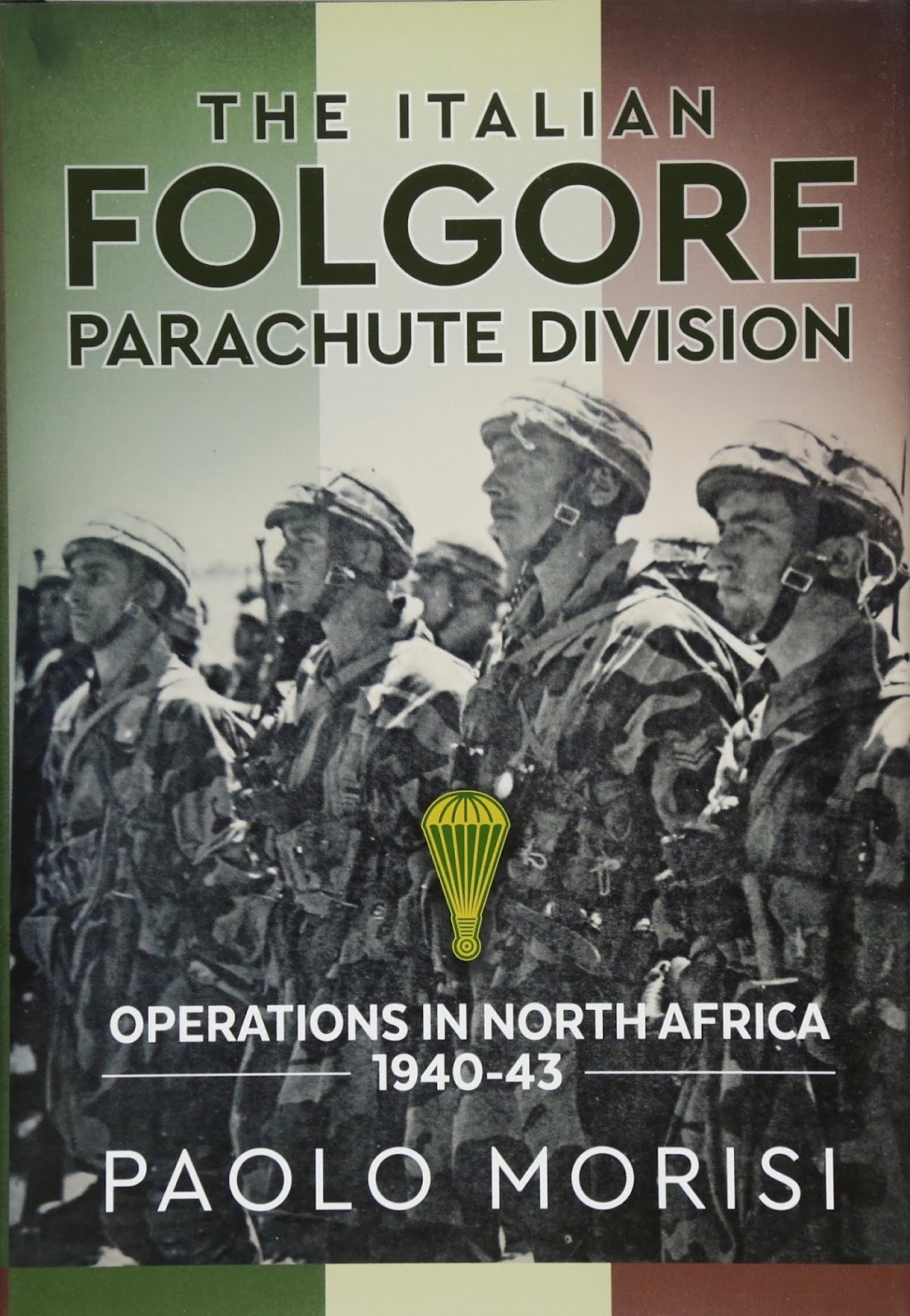
The Italian Folgore Parachute Division - Paolo Morisi

This review has been submitted to Military History Online.


Title: The Italian Folgore Parachute Division
Author: Paolo Morisi
ISBN: 978-1-911-09624-5
Publisher: Helion and Company
Year: 2016
Hardcover
Pages: 206
Photos/Maps: 84/9

Rightly or wrongly the Italian land forces of the Second World War are viewed as the poor cousins of the Axis alliance. A notable exception to this is the elite Folgore (Lightning) Parachute Division. Similar in nature to parachute elements in most armies, it was made up of the better officers and men of the Italian Army and was trained to a higher degree of skill and effectiveness. This book is a historical narrative of the development, operations and ultimate destruction of this unit.

Like many of its contemporaries, the Folgore was designed and equipped to be a light infantry element, thus it lacked prime movers, heavy weapons and other accoutrements that would impede its mobility. Initially developed with a view towards the invasion of Malta, when that was cancelled, it was rerolled into an infantry role in the African campaign. Unfortunately, it was not properly equipped for this new task and was ultimately trapped and, for the most part, destroyed during the Battle of El Alamien. The remnants continued to fight as the Axis retreated across the desert and was caught up in the final surrender of the Afrika Korps in Tunisia.

Morisi has presented a comprehensive analysis of the creation, recruitment, training and operational history of this Division. Its relatively short lifespan precluded it from earning the accolades that it perhaps deserved and this book is a focussed effort to redress that. The narrative is based upon extensive primary source material as well as interviews with surviving members of the Division and those that operated alongside and against it. Morisi has structured his work in a logical and engaging way placing particular emphasis upon the numerous operations that the Division was involved in. This is a very balanced rendition of the Units history as its strengths and weaknesses are discussed with equal candor. 

The quality of the publication is outstanding; typical of the Helion publishing house. The extensive maps and photographs also lend a visual appreciation to the narrative. I found this work to be very informative and thought provoking. Morisi has done an excellent job with his operational analysis and discussion of the larger strategic issues that affected the Divisions development and use. For those interested in a greater appreciation of one of the more effective Italian contributions to the Second World War, this book is recommended.

Strategy: Context and Adaption from Archidamus to Airpower - Richard J Bailey, James Forsyth, Mark Yeisley

This review has been submitted to Strategy and Tactics Magazine

Title: Strategy: Context and Adaption from Archidamus to Airpower
Editor: Richard J Bailey, James Forsyth, Mark Yeisley
ISBN: 978-1-682-47003-9
Publisher: Naval Institute Press
Year: 2016
Hardcover
Pages: 279

Strategy is a dynamic, living thing; intimately influenced by technology, geography, society and science. The editors have collaborated in bringing together a series of essays, each dealing with different aspects of strategy and its application and influence on the modern battlefield. The authors of the essays are academics, experts in their fields and all PhD instructors associated with the US School of Advanced Air and Space Studies. The intent of this work is to both promote and facilitate change in the way that strategy is perceived and applied.

The chapters of the book represent facets of strategy and strategic thought that are not necessarily appreciated by those inculcated into the more traditional strategic trifecta: politics, plans and execution within a military context. The broadening of the strategic scope enables the planner to better appreciate the environment within which they are obligated to work and execute their task. This holistic approach recognizes the need to approach strategy in a dynamic and non-linear fashion backstopped against a comprehensive education of strategic thought.

Concurrent to the task of strategic expansion is the need to blend this thought practice with the application of airpower theory; or how to undertake achieving the strategic goal within the boundaries and limitations of modern airpower principles. This is a challenging task, readily acknowledged by the authors, but one that is of critical importance if one is to be effective. Nevertheless, the work underscores the need to think of strategic aims and goals beyond the simple application of force; and to do so in a concurrent fashion. This further assists in meeting the constraints of the applied force of airpower.

In addition to its variety of thought-provoking essays, this work contains an extensive array of foot and endnotes that further clarify the discussion points of the authors. This proved very helpful as, with any essay, there are aspects that require expansion in order to facilitate understanding. The book is rounded out with a comprehensive bibliography of supplemental and relevant readings. The academic intent of this work, which is to help identify for the reader/student, what strategy is in its most basic form. However, the authors readily acknowledge that this question is an elusive target and that the book really aims at providing guidance on numerous methods by which strategy may be sought. In this respect the book is very successful.

The authors have created a work that covers a broad range of strategic analysis and method. In the case of this book, the emphasis focuses upon the use of strategy in relation to the effective application of airpower; however, it should be noted that the methods discussed in this work have a relevance far outside of the military application of strategy. The process of understanding the underlying methods of deriving strategy and its application is as important as the determination of strategic executions. This work helps guide the reader in this direction. 

Monday, 17 December 2018

Miracle at the Litza: Hitler’s First Defeat on the Eastern Front - Alf R Jacobsen

This review has been submitted to the Australian Naval Institute Journal

Title: Miracle at the Litza: Hitler’s First Defeat on the Eastern Front
Author: Alf R Jacobsen
ISBN: 978-1-612-00506-5
Publisher: Casemate
Year: 2017
Hardcover
Pages: 190
Photos/Maps: 71/8

Histories of the early stages of Operation Barbarossa, the German invasion of Russia, traditionally focus upon the line of activities running from the Baltic to Romania and the incredible successes that the Germans enjoyed during the first six months of that campaign. Lesser known but of longer term significance was the savage and austere fighting that occurred in the high arctic on the approaches to Murmansk. Jacobsen has drawn upon primary source material from the archives of Russia, Germany, England, Norway and Finland in an effort to address this shortcoming.

The book outlines the planning and execution of the German attacks across two lines of advance, the challenges faced and why they ultimately failed. He also provides a detailed account of the Russian and English efforts at countering these attacks. Ultimately these efforts, unlike the rest of the Eastern Front, were successful and served as an excellent example of joint operational planning and execution across both service elements and between the British and Russians.

Jacobsen does a noteworthy job of analyzing why the German/Finnish forces failed and it centers upon a few key lessons:

1.    A failure of German Intelligence to accurately determine the forces both physical as well as climatic facing them across the northern approaches to Murmansk;
2.    Failure to engage with the Finns early enough to have them provide meaningful input into the planning process;
3.    Failure of relations between German strategic, operational and tactical levels of Command and a resultant loss of trust and focus;
4.    German failure to maintain the schwerepunkt of attack and the subsequent reinforcement of failure as opposed to success between the Northern and Salla approaches to Murmansk; and
5.    A dilution of limited forces across the North.

Conversely, the author’s discussion of the Allied efforts also highlights certain lessons:

1.    The critical importance of effective joint operations (in this case naval and naval air) on both morale and flexibility;
2.    Effective intelligence; both the timely interception and effective use of;
3.    Allied engagement and the challenge of the perception of help versus tangible assistance on trust and cooperation;
4.    Ensuring that the correct assets are available to provide flexible response options to local commanders (in this case naval gunfire, submarine and naval air options); and
5.    The under-rated but critical importance of dogged resilience in effective defensive operations.

Jacobsen’s analysis and presentation of this previously underrepresented aspect of Operation Barbarossa is a nuanced, balanced and thoroughly readable work. The maps provided are somewhat busy and hard to follow but provide an adequate appreciation of elevations and the challenging nature of the environment. The book closes with a synopsis/analysis of the campaign by a former head of the Norwegian Armed Forces who lends a professional soldiers perspective from one who intimately knows the ground being fought over. Highly recommended.

Monday, 10 December 2018

Otto Skorzeny: The Devil’s Disciple - Stuart Smith

This review submitted to Soldier Magazine.

Title: Otto Skorzeny: The Devil’s Disciple
Author: Stuart Smith
Publisher: Osprey
Year: 2018
Hardcover
Pages: 384
Maps:  5
Photos: 44

Otto Skorzeny has been not been remembered kindly by historians. A hard line Nazi and self-promoter, he has been accused of taking the credit duly owed to others. Smith has produced a work that balances that assumption. Eminently readable and well researched, his book presents Skorzeny as both a courageous and dedicated soldier of Hitler as well as a vain and venal man; both facets are correct. The  Operations that he led are presented and analyzed in order to shed light on his strengths and weaknesses as a commander. Smith also provides a detailed background of Skorzeny before and after the war, providing the context needed to understand the man himself and his drives. Well worth a look.

Morning Star, Midnight Sun - Jeffrey R Cox

This review submitted to Sabretache Magazine.

Title: Morning Star, Midnight Sun
Author: Jeffrey R Cox
ISBN: 978-1-4728-2638-1
Publisher: Osprey
Year: 2018
Softcover
Pages: 448
Maps:  4

There remains a common misperception that, following their defeat at Midway, that the tide of war had turned definitively against the Japanese and that their ultimate defeat was now inevitable. Jeffrey Cox’s work proves this to be categorically false. That they had suffered a major setback was indeed the case and recognized but the Japanese still viewed the war as winnable.

This was a particularly enjoyable book to read; not only for its detailed content and analysis, but also for the humour and style of the author. Interspersed with his discussion of the events of the period covered by the book, are ‘sidebar’ interpretations of reactions of commanders and participants. These cynical interjections add levity and, indeed, a more human element to the narrative. The traditional stoic demeanour of the Japanese are given a more realistic feel. The Allies, a more truthful reflection of the strains of multinational as well as inter-service operations. 

Cox balances his narrative extremely well between the protagonists. The reader is provided with fascinating insights into the effects of fog of war, opinions and expectations of individual Commanders and a deep understanding of the pressures of command and the cumulative effects of decisions. During this period, both the Allies and the Japanese commanders were under great pressure to achieve clear victories. While the Americans had defeated the Japanese at Midway, they had lost a carrier in the process resulting in an operational draw. The American public demanded greater success. Conversely, the Japanese commanders felt compelled to avenge the stain of their Midway losses. Compounding this pressure was the fact that neither side, at this time, had the depth of resources to compensate for any additional losses of capital ships.

The author effectively captures the complex interplay between the adversaries as they struggled to control the seas and skies over the centre of gravity during this period: Guadacanal Island. The Japanese proved conclusively that they remained more than a match for the American forces facing them. In fact, they held a majority of the cards in terms of surface vessels, command quality, operational options and control of the seas. Having trained exhaustively for night operations, the Japanese continued to rule the night with the Americans maintaining an advantage during the daylight. Two things had changed however that are not widely appreciated but are glaringly obvious in Cox’s analysis: the Americans had finally found an Admiral in Halsey that had the aggressiveness and presence to take the fight to the Japanese and the vaunted “Sea Eagles”, the Japanese carrier aviators that had ruled the skies up to now, had been decimated and were a fraction of their former numbers. The replacement pool was unable to replace the losses with similar quality aviators.

Cox has drafted an outstanding book of exceptional quality and content. His narrative style is engaging and keeps the reader hooked. His comprehensive knowledge of this period is reflected in his deep analysis of the strengths and weaknesses of the American and Japanese forces. Regardless of whether one is interested in naval operations in the Pacific Theatre, this book remains not only and excellent reference but also read.

Sunday, 30 September 2018

On Tactics: A Theory of Victory in Battle - B.A. Friedman


This review has been submitted to Strategy and Tactics Magazine.

Title: On Tactics: A Theory of Victory in Battle
Author: B.A. Friedman
ISBN: 978-1-682471-63-0
Publisher: Naval Institute Press
Year: 2017
Hardcover
Pages: 241

The authors starts this work with the premise that Tactics, as a concept of war fighting, requires a reanalysis in light of the changes that have occurred in both the nature and execution of warfare. The re-examination focuses upon the elevation of tactics to a level that supplants the ‘operational’ level of command and a discussion on the traditional principles of warfare and their application to the modern battlefield.  

The book is not an easy read and requires patience to really glean what the author is looking to achieve. That is not to say that it is not well written but doctrine in and of itself requires thought and focus. In that light, this book demands considered deliberation.

He starts from the Clauswitzian school of the principles of war and decries the standard scholastic approach of rote learning and application. He emphasizes the need to avoid the trap of doctrine and its principles becoming dogma. Notwithstanding this position, Friedman does suggest an abridged, updated version that he identifies as being Tenets of War vice Principles. He postulates the difference as being one where Principles are rigid whereas Tenets are not. It is somewhat challenging to see where the line between the two is drawn but certainly, his suggestion is a good place for discussion and engagement. He divides his Tenets into three distinct categories: Physical, Mental and Moral. Follow-on chapters address each in more detail.

A central aspect of his analysis is his rejection of the Operational level of war. His position is that anything involving operations below the level of strategy is in fact tactics. To define an intermediary level is to inject un-necessary friction and confusion in the application of the Tenets. He does however, readily acknowledge the utility of an operational designation for those aspects that do not have a clear ‘home’ within the tactical or strategic levels (logistics, cyber, asymmetric, etc).

His assertion that those areas outside of the strategic/tactical sphere are in fact elements of operational art but not strategy or tactics in and of themselves is somewhat confusing. After all, in the modern age, cyber warfare for example, has become a means of engaging ones adversaries without any physical interaction and could therefore be defined as a method of achieving strategic aims.

The main body of the book is followed by a series of appendices that expand upon his positions vis-à-vis asymmetric warfare, the operational level of war, centre of gravity, training and structure. These are very helpful in clarifying how these various elements are incorporated (or not) into his assertion that Strategy and Tactics are the only two viable levels of war.

Overall, this work is an interesting salvo into an area that does deserve review. His position is certainly understandable; however, rejection of an operational level of command does run the risk of muddying the delineation of responsibility between commanders. Changes in capability, technology and methodology certainly underscore the need to look at how militaries control and command in war. This work suggests some interesting proposals.