Showing posts with label Command and Control. Show all posts

Sunday, 17 July 2022

Dunkirk: German Operations in France 1940 - Hans-Adolf Jacobsen

 This review has been submitted to Strategy and Tactics magazine.


Title: Dunkirk: German Operations in France 1940
Author: Hans-Adolf Jacobsen
ISBN: 978-1-612-00659-8
Publisher: Casemate Publishers
Year: 2019
Hardcover
Pages: 234
Photos/Maps: 0/14 

The Battle for and evacuation at Dunkirk may be very accurately viewed as a tactical victory for the Germans and a strategic victory for the British. The former were able to utterly defeat their adversary on the battlefield while the latter were able to save their army (minus equipment) to fight another day. This book, one of the “Die Whermacht in Kampf” series, examines the conduct of the battle and the reasons why the German failed to close the noose around the British army before it was able to escape. While the vast majority of the book is focussed upon the German’s efforts and actions, there is enough given over to the British and French to provide context. It is important to note that this series was undertaken originally in the 1950’s by German senior commanders and academics; and while they still did not have access to all of the primary source documentation (some was still in the hands of the Allies) relating to the event, they did take full advantage of the senior level participants and the primary source material that they did have. These studies are, in effect, a post mortem lessons learned about how the Germans executed their operations from both a command as well as a tactics perspective. 

Approximately two thirds of the book is given over to the execution of the operations leading up to the end of Fall Gelb (Plan Yellow – the initial invasion of France and the Low Countries; and the commencement of Fall Rot (Plan Red – the invasion of the main body of France). While this is interesting, it is not overly unique and has been presented in many other works on Dunkirk. What is the gem of this book is the analysis of the German senior command decisions that facilitated the British evacuations. Many modern works point to Hitlers Halt Order of 22 May which enabled the Allies to establish a defensive perimeter around Dunkirk. While it is true that the order was given, it was, in fact, von Rundstedt (Commander of Army Group A) who gave the order to halt and the author clarifies how and why this came about.  Additionally, and more interestingly, Jacobsen makes the argument, drawing upon primary sources, that there was in fact, three main issues at play: 1. the failure of a unified command structure for the Dunkirk Operation resulting in a failure to develop and execute a plan to destroy the Dunkirk bridgehead, 2. An assumption by the senior command in Berlin that Fall Gelb was, for all intents, finished (prior to destroying the Allied armies)and, as a result, attention was turned towards Fall Rot and units were withdrawn from Dunkirk that may have made an operational difference; and, 3. A failure of appreciation amongst the most senior of German commanders regarding the capability and role of the ‘fast units’ involved in the Dunkirk operation. 

This book is an excellent study in some of the less appreciated elements of German operations around Dunkirk. The maps provided are somewhat difficult to follow but nevertheless provide a visual appreciation of the battlespace. It is acknowledged by the authors that they do not have access to the breadth of primary source material that they would like but, even with this being the case, this work is well worth a read.


Thursday, 31 December 2020

Montgomery: Friends Within Foes Without, Relationships in and Around 21st Army Group - Malcolm Pill

This review has been published in British Army Review. 

Title: Montgomery: Friends Within Foes Without, Relationships in and Around 21st Army Group
Author: Malcolm Pill
ISBN: 978-1-912690-53-4
Publisher: Unicorn Publishing
Year: 2019
Hardcover
Pages: 303
Photos: 30

Montgomery has proven to be, along with Patton for the Americans, perhaps the most controversial of the British senior commanders of the Second World War.  That he was a brilliant commander (with an ego to match) has been analyzed in multiple biographies and studies; Pill however, has approached his study of Montgomery strictly from the perspective of his personal and command relationships with his immediate staff and, externally, with those leaders of the British, Canadian and American forces germane to his command relationships. Pill’s is a story of personality, style and expectations as opposed to operational or tactical scrutiny. 

Pill’s multifaceted approach reveals a great deal about the inner thoughts of Montgomery: what he saw as important, how he viewed the execution of the war, what were the events and experiences that shaped both his and those with whom he interacted, perspectives and what influenced his decision making. While he has drawn upon a multitude of sources, it is the personal diaries and letters (he was a prodigious chronicler) of Montgomery and his confreres where Pill is able to shed light on the inner thoughts of the man. Unlike memoires which, written in the immediacy of the moment, are a much better source for glimpses into the honest thinking of the authors.

The author has divided his narrative into a series of sub-sections that fall broadly into Montgomery’s dealings with subordinates within 21st Army Gp, allies (and external commands) and operations within which he was involved. Pill’s engaging account casts a critical light not upon Montgomery’s capabilities as a tactician and operational planner, but upon his confidence and competence as a leader and commander. Much of the controversy, Pill conclusively proves, that Montgomery was involved with, was of his own making and not the result of external circumstance. Montgomery’s experience as commander of the 8th Army in North Africa and his subsequent endearment to the British nation as the ‘victor over Rommel’, ultimately led him to fall victim to that all too common occurrence of ‘believing his own press’. As Pill observes, this loss of humility resulted in an inflated sense of self that was toxic to relations with those not under his direct command. Montgomery’s inability to acknowledge the competencies and effectiveness of others outside of his immediate control was his Achilles heel and undermined much of the cooperation and support that he might otherwise have enjoyed.

This is a unique and fascinating account of the man and the commander that was Montgomery. The reader is left with the impression that, once the war ended, he struggled to find his place. Certainly his relations with a majority of his subordinate commanders remained good in the years following the war but the fact that he had burned so many bridges within the British command community and on the international stage precluded his being considered for many positions that he would otherwise have been eminently qualified for. Pill has done his research and his book serves as an excellent example and warning for those leaders who come after.


Wednesday, 20 May 2020

Destination Dunkirk: The Story of Gort’s Army - Gregory Blaxland


This review has been submitted to Reveille Magazine.

Title: Destination Dunkirk: The Story of Gort’s Army
Author: Gregory Blaxland
ISBN: 978-1-52673-523-2
Publisher: Pen and Sword Books
Year: 2018
Hardcover
Pages: 436
Photos/Maps: 53/24

The Battle of France and the Low Countries commenced 10 May, 1940, and was an unmitigated success for the German military. In six weeks they had accomplished what their forefathers could not in four years of fighting, the collapse and occupation of France. Much has been written about this campaign with ad-nauseam analysis of what the Germans did right and the Allies (especially the French) did wrong. What has received relatively little in the way of attention was the role played by the British Expedition Force (BEF) who fought alongside the French in country well known to many of the World War 1 veterans now returning as senior Officers and NCO’s. While the British contribution to this campaign (in terms of land forces) was relatively small compared to the French and German armies, they nevertheless occupied key territory linking the French and Belgian armies along the River Dyle in Eastern Belgium. Their war was a short but sharp one; first contact on May 12, leading to evacuation from Dunkirk end May, and the last troops departing on June 17 from Nantes and St Nazarine.

The author was a member of the BEF and was evacuated on May 31st from Dunkirk. His narrative is based therefore, not only on the official war diaries of the French, British and German units involved but also upon his and his peers’ personal records and recollections. His unique experience, having actually lived what he was writing about, has enabled him to pass on to the reader a perspective replete with anecdotal and documented information couched with a historian’s eye.

This version is a reprint of the original from 1973. The quality of the writing is excellent, conveying a real sense of the shock as the German juggernaut crashed into the unblooded British; driving them irrevocably back. It is noteworthy that the British forces did not collapse as did many of the Belgian and French, but were able to maintain cohesion and discipline as they retreated along roads choked with refugees and allies. Blaxland’s writing further underscores the absolute confusion amongst the Allied Headquarters as they struggled to deal with crisis followed by crisis. This work represents an excellent study in crisis planning and initiative amongst the British leadership while highlighting the utter failures of nerve and coordination amongst the Allies.

Included in the work are many maps outlining the unfolding struggle; while helpful, they are of average quality and would have benefitted from a rework. The author has also included a series of appendices that lay out in detail the formations included in the BEF, an outline of the main weapons systems and their capabilities in a comparison of German, French and British forces and finally a detailed rendition of source material broken out by chapter. Thoughtful, balanced and deeply informative, this is truly a worthwhile rendition of the BEF experience in France and a noble testament to its officers and soldiers.

Thursday, 2 May 2019

Five Days From Defeat - Walter Reid

This review submitted to British Army Review.

Title: Five Days From Defeat
Author: Walter Reid
ISBN: 978-1-78027-490-4
Publisher: Birlinn Books
Year: 2017
Hardcover
Pages: 256
Photos/Maps: 19/2

Following the commencement of the massive German offensive in March, 1918, the Allies were rocked back on their heels as the front was ripped open and the British 5th Army collapsed in disarray. Popular history suggests that Field Marshall Douglas Haig, commander of the British and Commonwealth forces, was instrumental in coordinating the Allied response; maintaining his composure while those around him lost theirs. In fact, to read his biographies and memoires, one could very easily believe that he was the driving force behind the concept and implementation of the Joint Command structure that the Allies ultimately adopted under French leadership.

Reid’s intent is to provide a counterpoint to much of the narrative pertaining to the British role in the last year of the war. To that extent, he has approached his study in a very structured manner; breaking the discussion into pre-1918, the period of the Spring Offensive, the Five Days and the last 100 Days. Why this is important is that enables the reader to understand both the military and political standings and motivations of the three major players (France, Great Britain and Germany) leading into the final push. Reid has done a commendable job at setting the stage for the drama of the Spring Offensive by shining a light onto the difficult relationship between Haig and George (the British PM). Haig comes across as a very egotistical Commander and was a key impediment to any form of change in the Command relationships between the Allies. Additionally, Reid clearly shows that, in the eyes of the British public, he was also seen as the lynchpin holding the West together.

He then goes on to break down the five critical days of the Spring Offensive and the reactions of the various national players. Extensive analysis of primary source documentation reveals significant disconnect between the accepted British (read Haig) inspired history and what the documents tell us. Haig, far from the decisive unflustered Commander that he wishes to be remembered as, was, in fact, very much prepared to retreat along the British lines of communications to the French ports in anticipation of evacuating the Army. In his defence, the Germans had shattered the 5th Army and was collapsing the 3rd and he did have orders to protect the last Army that Britain could effectively provide. Nevertheless as Reid has suggested very convincingly, much of what occurred as a result of the Spring Offensive happened around and in spite of Haig, not because of him.

Reid’s book is an interesting analysis of the relative state of the commanders of the three major powers. It sheds light on the role of the media in developing and maintaining both a perception of individuals as well as being a tool in the challenge of civil/military relations within the British hierarchy at this time. His discussion of the efforts of the civilian governments (especially amongst the British) to wrest back control of the war from the Generals is a telling example of the failure of clear delineations of responsibility. A very interesting read and a worthwhile addition to any library or collection.

Dak To and the Border Battles of Vietnam, 1967-1968 - Michael A. Eggleston


This review submitted to Canadian Army Today Magazine.


Title: Dak To and the Border Battles of Vietnam, 1967-1968
Author: Michael A. Eggleston
ISBN: 978-1-4766-6417-0
Publisher: Mcfarland Books (McFarlandBooks.com)
Year: 2017
Softcover
Pages: 224
Photos/Maps: 19/24

The battles in Vietnam were reaching a peak as the 1960’s moved into their final years. Generally, the sense has been that the United States was fighting the wrong war for the wrong reasons and that the advantages lay predominantly with the North Vietnamese. Included in these were the willingness to absorb causalities, the sense that this war was of national importance, the ineffective and corrupt nature of the Southern Vietnamese government, the ineffectiveness of the Southern Vietnamese Army and the control that the communist regime in Northern Vietnam exercised over its people and resources. While much of this was true, the United States and its Allies were not without deep capabilities and the North Vietnamese not without weakness and internal division.

Eggleston’s book sheds light upon some of the key events in the entire Vietnam War: the period leading up to the Tet Offensive. Much has been written about the actual Tet Offensive, while relatively little has looked at the American and North Vietnamese strategies leading up to this Offensive. Each side achieved its initial aims with the Border Battles: the Vietnamese to draw American forces out of the cities and into the countryside and the US to draw Vietnamese forces into more traditional set piece battles where they could be destroyed.

This is an excellent book to read in order to gain an appreciation of the nature of the conflict during this period. He expertly combines a sweeping synopsis of the history and nature of the war up to the Border Battle period and then delves in more detail regarding the scope of this engagement. Of particular poignancy, the author has drawn upon firsthand accounts of participants from both sides; by including them as written, he ensures that the reader has great difficulty putting the book down due to their realism and the raw emotion elicited. I have rarely come across such descriptive and emotive recollections.

This is a book focussed on the soldiers and their experiences at the front; in the thick of battle. Eggleston does not spare those who were not equal to the leadership task nor those who failed in their responsibilities to their soldiers. It is interesting to note the comments related to the American leadership practice of senior commanders trying to conduct operations from helicopters (the idea being that one would be able to maintain a much better grasp of the battlefield). Additionally, discussions about the terrain and the unique nature of fighting the regular North Vietnamese Army units vice Vietcong are also very enlightening. Finally, the failure of the North Vietnamese to appreciate the ability of the US command to reposition its forces undermined the ability of the North to achieve its desired end state with Tet.

I recommend this book. It is not an in-depth analysis of the politics of the war, more a treatise on the nature of tactical level combat in the Vietnam theatre and its effects upon soldiers at the squad and platoon level. Disturbing, enlightening and poignant in equal measure.

Monday, 18 March 2019

Instrument of War: The German Army 1914-18 - Dennis Showalter


This review was submitted to Strategy and Tactics magazine. 

Title: Instrument of War: The German Army 1914-18
Editor: Dennis Showalter
ISBN: 978-1-4728-1300-8
Publisher: Osprey
Year: 2016
Hardcover
Pages: 304
Photos: 43

The German Army had a reputation leading up to the beginning of World War 1 that placed it squarely at the top of equivalent European Armies. Based mainly upon its performance during the Wars of German Unification (Denmark and Austria) and the Franco-Prussian War, it was perceived to be, in many respects, the standard to be emulated. Showalter approaches his topic with this in mind and investigates whether this reputation was still deserved just prior to World War 1. He further examines how the Army and its command structure morphed as the War continued and the impact that this had on its effectiveness and resiliency.

His analysis commences with a brief overview of the national character of the army and its various levels of personnel readiness. This sets the stage for his discussion of the army and the commencement of the war. Showalter is very balanced in his praise and criticism of the army and the reputation that it had. He postulates that the Army was the wrong tool for the Schlieffen Plan and that German Senior leadership failed to appreciate its limitations, specifically in the areas of mobility and communications, ultimately resulting in the plans failure. He further  convincingly postulates that, while the Army was superior in many ways to its contemporaries, the German Leadership was extremely limited in their strategic grasp and could not decide upon priorities of effort following the failure of the Schlieffen Plan.

Showalter effectively encapsulates the rise and fall of German fortunes as the war descends into one of stalemate and attrition in the West and supporting a weakened Austro-Hungary in the East against Russia and Italy. He shows that for a good part of the war, Germany was superior at the tactical and operational levels; engaging in the use of aircraft, gas, storm troop tactics and the command empowerment of NCO’s and Junior Officers. He is, however, merciless in his criticism of the senior German leadership; its infighting, hubris, political intrigue and ultimate failure to acknowledge the necessity of working in tandem with the diplomatic elements of the Government as well as not recognizing the self-destructiveness of the war.

The theme throughout his book is that the main enemy of Germany was time. Every year weakened them and strengthened their adversaries, allowing the Allies to learn and close the gap between their respective armies. Compounding this was the diminishing pool of manpower available to Germany with which to make good its losses.

Showalter has proven himself to be an impartial judge of the German Army of this period; balanced in his praise and criticism. He draws attention to elements of German leadership and planning that are not necessarily readily apparent in many of the narratives of this war. There is no question that the Germans could have won the war given slightly different circumstances but, as Showalter points out, this would have been in spite of rather than because of the strategic level decision making. Despite its institutional weaknesses, the German Army proved itself to be an instrument of formidable depth and resilience; able to match the Allies right up until the last months of the War. Showalter gives the reader much to think about and ponder from his noteworthy analysis of this machine. A well-researched and very interesting book.

Wednesday, 26 December 2018

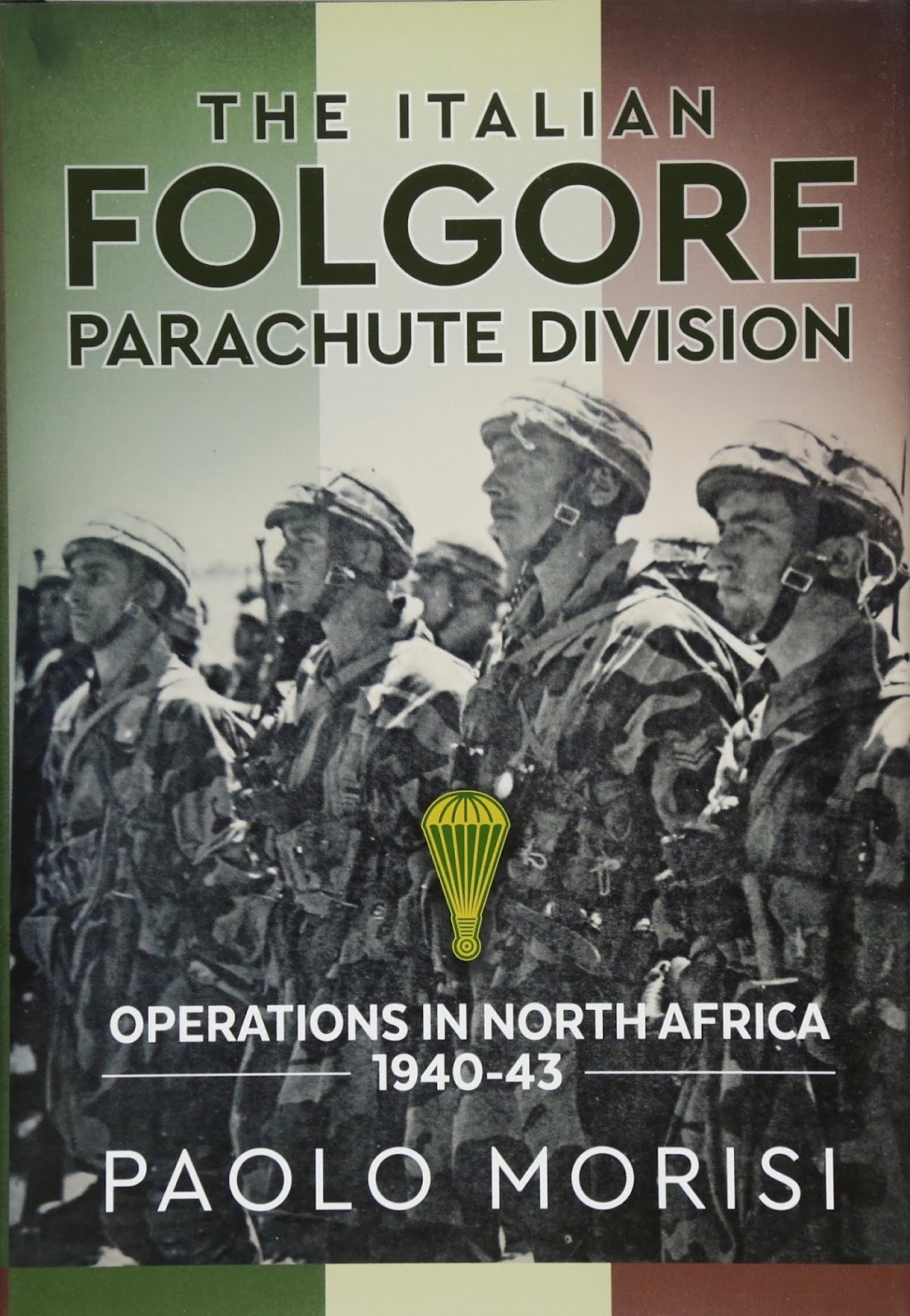
The Italian Folgore Parachute Division - Paolo Morisi

This review has been submitted to Military History Online.


Title: The Italian Folgore Parachute Division
Author: Paolo Morisi
ISBN: 978-1-911-09624-5
Publisher: Helion and Company
Year: 2016
Hardcover
Pages: 206
Photos/Maps: 84/9

Rightly or wrongly the Italian land forces of the Second World War are viewed as the poor cousins of the Axis alliance. A notable exception to this is the elite Folgore (Lightning) Parachute Division. Similar in nature to parachute elements in most armies, it was made up of the better officers and men of the Italian Army and was trained to a higher degree of skill and effectiveness. This book is a historical narrative of the development, operations and ultimate destruction of this unit.

Like many of its contemporaries, the Folgore was designed and equipped to be a light infantry element, thus it lacked prime movers, heavy weapons and other accoutrements that would impede its mobility. Initially developed with a view towards the invasion of Malta, when that was cancelled, it was rerolled into an infantry role in the African campaign. Unfortunately, it was not properly equipped for this new task and was ultimately trapped and, for the most part, destroyed during the Battle of El Alamien. The remnants continued to fight as the Axis retreated across the desert and was caught up in the final surrender of the Afrika Korps in Tunisia.

Morisi has presented a comprehensive analysis of the creation, recruitment, training and operational history of this Division. Its relatively short lifespan precluded it from earning the accolades that it perhaps deserved and this book is a focussed effort to redress that. The narrative is based upon extensive primary source material as well as interviews with surviving members of the Division and those that operated alongside and against it. Morisi has structured his work in a logical and engaging way placing particular emphasis upon the numerous operations that the Division was involved in. This is a very balanced rendition of the Units history as its strengths and weaknesses are discussed with equal candor. 

The quality of the publication is outstanding; typical of the Helion publishing house. The extensive maps and photographs also lend a visual appreciation to the narrative. I found this work to be very informative and thought provoking. Morisi has done an excellent job with his operational analysis and discussion of the larger strategic issues that affected the Divisions development and use. For those interested in a greater appreciation of one of the more effective Italian contributions to the Second World War, this book is recommended.

Friday, 14 September 2018

East of Chosin: Entrapment and Breakout in Korea, 1950 - Roy E Appleman

Title: East of Chosin: Entrapment and Breakout in Korea, 1950
Author: Roy E Appleman
ISBN: 978-0890962831
Publisher: Texas A & M UP
Year: 1987
Hardcover
Pages: 361
Maps:  11
Photos: 41

The advance of UN forces into North Korea and the region of the Yalu River following the landing at Inchon in 1950 is well known and studied. The subsequent surprise attack by overwhelming Chinese infantry forces and the collapse of the UN drive followed by the desperate fighting retreat of the Marines of X Corps from around the Chosin Reservoir stands as one of the defining moments of the Korean Conflict. Lesser known but no less dramatic was the tragedy of the Army’s 31 Regimental Combat Team (RCT), destroyed while attempting to retreat after defending the 7th Marines Eastern flank.

The author has drawn upon the first hand recollections of survivors as well as declassified documents from the Army and Marines to paint a comprehensive picture of a unit that circumstance, hubris and poor planning had destined for disaster. Additionally, he also relates a story of individual courage, tenacity and will on the part of individual soldiers and officers. Make no mistake however, Appleman pulls no punches in his rendition of selfishness and appalling leadership collapse.

It is a maxim that one’s true nature is revealed during times of intense stress and hardship; the experience of 31 RCT highlights this fact in glaring detail. If nothing else, this tragedy serves as a teaching tool on leadership under adverse conditions. The collapse of the command structure and the subsequent deterioration of the 31 RCT from a military unit into a mob of individuals within a matter of hours is a harsh testament to the necessity of maintenance of unit cohesion and discipline and the critical roles of the NCO’s and Officers to that effect

There are many lessons to be gleaned from this work:

1.    The critical necessity of maintaining communications;
2.    The role of the Commander and where they need to be in order to ensure accessibility and the maintenance of operational control;
3.    Clear planning and ensuring that sub-units understand their roles and responsibilities;
4.    Anticipation of requirements. Commanders must not micromanage but focus on what is required next;
5.    Logistics: the need to identify critical requirements and the absolute necessity for the Command to deliver based upon those requirements
6.    The critical role of junior Officers and NCO’s in maintaining unit cohesion and discipline; and
7.    The need for inter-service cooperation and a common operating environment.

The experience of the 31st RCT in Chosin should be studied by leadership academies and used a teaching tool for how not to undertake an operation. Individuals involved within the 7th Marines and the RCT certainly rose to the challenge of the occasion and serve as examples for others to emulate; however, overall, the lessons of this tragedy are more akin to what not to do rather than the opposite.

Monday, 20 August 2018

Whispers Across The Atlantick - David Smith


This review has been submitted to the Canadian Army Journal. 

Title: Whispers Across The Atlantick
Author: David Smith
ISBN: 978-1-4728-2795-1
Publisher: Osprey
Year: 2017
Hardcover
Pages: 292
Maps:  5
Photos: 15

General William Howe was appointed the Commander of the Crown forces deployed to crush the rebellion that had broken out in the United States in 1776. The British Navy had unchallenged control of the seas and its land forces a heavy professional advantage over the American rebels. Things unfortunately did not go nearly as planned for the British; hampered by hubris, personal animosity between the commanders of the different British and German (the British Crown had hired German mercenaries) units, a failure to prioritize and focus on the primary task of destroying the rebel army and a marked failure to undertake operations with drive and urgency resulted in a growing dissatisfaction and a loss of confidence with Howe by the British Government. His resignation after the 1777 campaign season and the subsequent public enquiry in the House of Commons form the basis of the book.

I particularly enjoyed Smith’s approach to his narrative. Each chapter commences with the pertinent element of Howe’s speech to the House followed by an evaluation of the contents by the author (taking advantage of the benefit of hindsight). The chapter that follows expands upon the actions of the various antagonists during the period covered. This approach makes for a much clearer understanding of what the perceptions of Howe were at the time as compared to the reality of his actions on the ground.

The degree to which commanders relied upon the initiative of their subordinates during this period is clear. Limitations in communications and the challenges of operating along very limited axis’s of advance (in many cases consisting of rivers or game tracks) resulted in decisions being made based upon information that had been overtaken by events. More to the point though an explanation of the failure of the British to attain victory during these critical early years, lies in the authors analysis of Howe as a commander and his failure to grasp the operational and strategic options that would have destroyed the capacity of the Americans to continue the war. It is clear that Howe was not an incompetent General but that he was a man out of his depth in the combined symmetric and asymmetric styles of warfare that constituted the Revolution.

Additionally, Howe’s efforts were impeded by the inflexible position assumed by the British government in relation to the demands of the American colonists. His orders to destroy the various colony’s infrastructure as a means of undermining the will of the revolutionaries combined with a refusal to even acknowledge their grievances, ensured a steady and growing level of support for the insurrection. Smith discusses this challenge in some detail.   

Osprey has published a very good quality book. The main drawback to the content of the book itself is the quality of the maps. They are reproductions of the original maps produced at the time for the consumption of the British public and are, unfortunately, difficult to read and follow. Otherwise the narrative is excellent, the bibliography extensive and the font large enough to read easily. I very much enjoyed this book as it shed light upon the nature of 18th century command as well as the challenge of conducting a war from a distance. Recommended.

Wednesday, 8 August 2018

A Genius for War: The German Army and General Staff 1807-1945 - Col T.N. Dupuy

Title: A Genius for War: The German Army and General Staff 1807-1945
Author: Col T.N. Dupuy
ISBN: 0-13-351114-6
Publisher: Prentice Hall
Year: 1977
Hardcover
Pages: 363
Maps:  19
Photos: 74

 Students of modern military history will agree that one of the most influential elements of the modern command system in most if not all countries has been the legacy of the German General Staff System, developed under the auspices of The Reformers (Scharnhorst, Gneisenau, Clausewitz, Grolman and Boyen) following the collapse of the Prussian military at the Battles of Jena and Auerstadt in 1807. Dupuy’s work traces the development, institutionalization and influence of this system on the German military and, by extension, State up to the end of 1945.

This is a brilliant analysis of the staff system. Revolutionary in scope and visionary in implementation; it served to transform the Prussian and German States from a third rate power to the standard by which other militaries were measured. While the narrative is clear and logical, there are three elements which stand out as being key to the success and ultimate failure of the German military.

The first two and the foundation of the system (and that which gave it such resiliency and capacity) was the Founders success at “Institutionalizing Military Excellence”. This entailed ensuring the development and maintenance of a military as free as possible from the ‘vagaries of change’ resultant from human fallibility. In effect ensuring military excellence regardless of the influence of changing leadership. Dupuy provides an insightful and concise discourse on how the Germans developed a process of ensuring an Army of consistent and reliable ‘Organizational Genius’ while concurrently providing the structure within which leaders of ‘Operational Genius’ were developed. Additionally, the military leadership was to remain aloof and disconnected to the political machinations of the State.

The third aspect that they endeavoured to implement, but were ultimately unsuccessful, was ensuring that the military and its leadership were seen and understood to be tools of and accountable to the people of Prussia and ultimately, Germany. Where this failed was in the relationship between the Kaiser and the Reichstag (or Parliament). The Kaiser insisted upon an Army that was loyal to and controlled by Him. Thus it was that the leadership and the Army swore fealty to the Kaiser and not to Germany (as represented by the people).

The book goes a long way towards providing an explanation as to why the German Army remained an effective, focussed fighting force right up until the last days of the Second World War. It also, by extension, explains why the military did not intervene with the rise of Hitler and also swore an oath to him. Dupuy’s analysis shows the strength of the system that the Germans had created and how it translated into such an effective military force. Additionally, the dangers of providing such an effective tool to an individual as opposed to an accountable entity is also made abundantly clear.

This is a great book, logically laid out and comprehensive in its scope. It serves as an outstanding review of the strengths and weaknesses of the German Staff system.

Sunday, 7 May 2017

Swords Trembling in Their Scabbards - Michael Creese

This review has been submitted to WarHistoryOnline.

Title: Swords Trembling in Their Scabbards
Author: Michael Creese
ISBN: 978-9-099-82819
Publisher: Helion Publishing
Hardcover
Publication Year: 2015
Pages: 202
Illustrations:  10 B/W

The relationship between the British and Indians underwent fundamental changes commencing at the turn of the 20th Century. This was especially the case with the advent of the two world wars. No where was this change more pronounced than in the Army. Traditionally officered by the British, either regular force or as members of the East Indian Company, necessity, professional development and maturity witnessed the advent of Indianization within the army and the creation of an Indian Officer corps.

Creese’s book undertakes a study of how this transition came about and how this change was accepted by the members of the military. This work is an expansion of the autho’rs thesis and is a well researched and balanced study. It is somewhat of a dry read but it does relate the story of development of the Corps, specifically focusing on the experiences of one of the early commissioned Indians Amar Singh who maintained a detailed diary of his experiences.

Creese’s analysis clearly shows that the transition was not always easy nor smooth. The British, especially in the period following the First World War certainly recognized the need and inevitability of the change of Indian status.. Availability of British forces to man the Regiments as well as noteworthy Indian performance in the cauldron of the trenches all pointed towards change. Nevertheless, while many accepted the changing status it required a shift in the paradigm of both the British troops and officers. As Creese points out, this was not a one way street however; the perspective of the Indians themselves and their abilities also underwent profound change as they found themselves conducting operations against Western adversaries and being more than equal to the task.

The author has drawn upon extensive primary source material and his work is obviously well researched. His study of the transition outlines the changes at both the societal as well as the military level. The work addresses some of the misconceptions regarding the relationship of the British  and Indians serving within the military. Unlike other aspects of the administration, to a great extent the British leadership recognized and actively supported the elevation of competent Indians to positions of authority. This extended to the creation of a military academy along the lines of Sandhurst. Creese points out that the transition was in fact facilitated by the fact that the methodology and doctrine was seamless between the British and Indians as both were trained in the same manner.


While the work is academic in nature, any reader with an interest in societal change and the profound impact that the transition within the Indian military had on the stability of the independence of India itself, would do very well to read this book.

Wednesday, 28 December 2016

Three German Invasions of France – The Summer Campaigns of 1870, 1914 and 1940 - Douglas Fermer

This review has been submitted to the British Military History Journal


Title: Three German Invasions of France – The Summer Campaigns of 1870, 1914 and 1940
Author: Douglas Fermer
ISBN: 978-1-781593-54-7
Publisher: Pen and Sword
Year: 2013
Hardcover
Pages: 273
Photos/ Maps: 30/11

Germany and France have maintained a difficult relationship stemming back to the pre-German unification period of Prussia and Napoleonic France. Three wars were fought between the two nations during the 70 years from 1970 until 1940; each reflecting a period of political, doctrinal and societal change within each nation state. Fermer’s book looks at the root causes and the execution of these wars with a view towards highlighting the impact on these conflicts upon the French army and society primarily and upon Germany secondarily.

Fermer’s analysis is balanced and insightful. Despite the breadth of the topics that he has undertaken to review, he does so in a very succinct manner; the renditions of his observations easy to follow and well developed. His approach is to look at each of the individual engagements as a part of a greater whole. This facilitates a linear examination that clearly identifies the connections and causation's between the wars.

He has divided his book into four distinct parts, each addressing the individual conflicts as well as the precursor period in France leading up to 1870. Each section establishes the environment of the period and the main changes that had occurred as well as the main lessons to be learned from each encounter. Central throughout is the political atmosphere which remains the main cause of the military escalation between the nations. The use of the military as a tool of political gain must be balanced and extremely carefully applied; Fermer shows that, leading to 1870, the Germans were extremely adept at this but that limitations in political acumen by both participants made themselves felt to a greater degree as time went forward. Hubris on the part of both French and German leadership was legion.

Fermer also undertakes a detailed evaluation of the impact of success upon both the victor and vanquished both doctrinally and psychologically. His investigation reveals that the German use of lessons learned following their actions were far more in depth (and taken far more seriously) than their French counterparts. The French were further handicapped by their political instability and ongoing intra-national divergence. This manifested itself in inconsistent recruitment and armament policies as well as challenges in foreign policy.


Also, included in the book is a comprehensive listing of the references that he has utilized; of particular note is the number of primary source documents. Overall this is an outstanding rendition of the turbulent period encompassing these three conflicts. The author has drafted a narrative that recounts the characteristics of the conflicts themselves, the underlying causes (primary, secondary and beyond) and the results politically, militarily and socially thus providing the reader with a complete understanding of this period. Fermer’s book is an excellent account and source. 

Monday, 5 December 2016

Moltke and His Generals – A Study in Leadership - Quintin Barry


This review has been submitted to the Canadian
Army Journal.

Title: Moltke and His Generals – A Study in Leadership
Author: Quintin Barry
ISBN: 978-1-910294-41-3
Publisher: Helion and Company
Year: 2015
Hardcover
Pages: 304
Photos/ Maps: 20/9

Helmut von Moltke was one of the most influential military commanders of the 19th century. During his tenure as first Chief of the Prussian General Staff followed by Chief the Great General Staff, Moltke oversaw the strategic success of the Prussian/German forces in three major conflicts: Denmark (1864), Austro-Prussian (1866) and Franco-Prussian (1870-1871). His vision and drive created a military command structure that was unparalleled in the European theatre in the form of the Great General Staff. He was supported by a senior strategic and operational staff that was developed through this system and therefore had a common understanding of expectations.

Barry’s work undertakes a study in detail of the personality and influence that Moltke and his senior officers had on the period. His analysis is balanced, critical and insightful. His observations on the challenges of personality upon the effective execution of the mission is instructive, emphasizing that despite a common training regime and mission, allowance for and encouragement of independent action must be grounded in solid discipline and command maturity.

The author dedicates a chapter to each of the major commanders reporting into Moltke. It is very instructive that not all are seen as effective; indeed his analysis is critical of many of them as the impact of personality and hubris made themselves felt. It is revealing however, just how effective was the Prussian/German command structure in minimizing the short comings of individual commanders via the strengths of the Chief of Staff appointed to that commander. The Prussian system, refined and enhanced by Moltke, deliberately assigned ‘teams’ of Commanders and Chiefs of Staff that offset the other’s weaknesses. Strength was thus a product of the whole as opposed to the individual.

Additionally, Barry reviews the development of the ‘Commanders Intent’ as a foundation of the German command system. During a period of difficult and unreliable communications, this provided Army and Unit commanders with the parameters within which they could exercise individual initiative in order to achieve Moltke’s stated aim. Barry looks at what are the training and developmental requirements needed to effectively develop the trust and understanding in order to ensure the effectiveness of this command style.

This work is an excellent analysis of the personality and impact that Moltke’s initiatives brought to the German General staff. Beyond that, it discusses at length the methodologies needed to build and lead the command environment created by this decentralized style. Moltke’s confidence in his subordinates and his innate ability to understand when to not intervene are traits modern commanders should be striving to emulate. This book is both an insightful and worthwhile read; interesting while avoiding the pitfalls of an excessive ‘academic’ style. The production quality of the book is high with Helion’s standard attention to detail. As well, Barry provides the reader with an extensive bibliography on Moltke himself as well as the three major conflicts that he acted as overall commander of.

Thursday, 11 August 2016

The Viaz'ma Catastrophe - Lev Lopukhovsky


This review was submitted to the Global War Studies Journal

Title: The Viaz'ma Catastrophe
Author: Lev Lopukhovsky
ISBN: 978-1-908-91650-1
Hardcover
Pages: 576
Illustrations:  21 B/W, 15 maps
Publisher: Helion Publishing

1941 the armed forces of the USSR were on their heels. Pushed back to the approaches to Moscow they continued to fight a tenacious and increasingly desperate rearguard action against the cream of the German Wehrmacht. Drawing upon seemingly endless resources of men (and material) the Soviets strove to crush the German advance through a series of Army level counterattacks. The Wehrmacht, for their part, continued their grand enveloping maneuvers, encircling and crushing the Russian forces in their path. The Battle of Viaz’ma and Orel-Briansk represented for the Germans what they assumed to be the final barrier to their final advance on Moscow. Between these two battles of encirclement over the first three weeks of October, 1941 the Russians lost between 900,000 and 960,000 men; a crushing defeat by any standard.

​Lopukhovsky is another of the new wave of Russian historians who have taken advantage of the relaxation of the archival access laws in order to draw upon primary source material from the Russian/Soviet perspective. Commencing with a detailed synopsis of the events leading up to the commencement of Operation Typhoon (the final German drive on Moscow), the author provides the reader with a comprehensive baseline of the situation facing the Soviets. This is one of the few histories of this battle written in the post-Soviet era, from the perspective of the Russians. The level of detail is staggering and the accompanying maps and tables add a degree of clarity rarely enjoyed in a book of this complexity. Stuart Britton who has undertaken the translation of this book from its original Russian is to be commended for another outstanding endeavor.

​The author identifies key themes relating to the Soviet performance:

1. The reluctance on the part of senior commanders to both provide and accept factual information thereby undermining decision making and situational awareness;
2. the ferocity and tenacity with which the Soviet soldier defended their positions against overwhelming German superiority; and
3. the reluctance of Soviet commanders to make and take responsibility for decisions.

Additionally, he author interjects into his narrative with personal observations relating to his efforts to clarify questions with the senior Soviet commanders in the postwar Soviet era. It is fascinating the degree to which these efforts were met with official roadblocks whenever any 'questionable' positions were challenged. Notwithstanding this fact, it is also interesting how, despite the position officially of the State, candid ex-senior commanders were willing to be in correspondence with the author.   

Overall, an outstanding book and a highly recommended addition to those seeking to expand their understanding of the challenges that the Soviet's struggled with in trying to contain the German Typhoon of 1941. It is a sobering and humbling rendition of the sacrifice of the Russian soldier and the dysfunction of their leadership.

Thursday, 30 June 2016

Prelude to Blitzkrieg: The 1916 Austro-German Campaign in Romania - Michael B Barrett

Title: Prelude to Blitzkrieg: The 1916 Austro-German Campaign in Romania
Author: Michael B Barrett
ISBN: 978-0-253-00865-7
Publisher: Indiana University Press
Year: 2013
Hardcover
Pages: 399
Photographs/Maps: 33 b/w//15


1916 was characterized by huge and bloody battles that chewed up literally 100,000’s of men for little or no gain to either side (the Brusilov Offensive in the East and Verdun and the Somme in the West standing as key examples). Romania, who had up to this point, remained neutral despite initial leanings towards the Central Powers (CP), had its eye on the Transylvania region of the Austro-Hungarian Empire; an area that had traditionally rested within the Romanian sphere of influence. With assurances for material and manpower support from both Russia and the West, Romania made the decision to undertake a surprise strike on 27 August into Transylvania. The German-Austrian response, against all expectations in the West, was both decisive and conclusive; within 135 days the Romanians had been crushed. The significance of this victory can be gauged by a comparison between the Somme and Romania. In an almost identical period the Central Powers covered 360 miles in Romania while the Allied powers moved 7 miles in the Somme.

Barrett’s book analyses what was done differently by the Germans and Austrians and the effect that it had upon tactics at the operational level. Two significant issues set the conditions for CP success: the limited resources available to counter the Romanian incursion and the removal of General von Falkenhayn from his post as German Chief of Staff (due to the Verdun debacle) and his resultant availability to command in Romania. Barrett shows that the limited resources necessitated a significant change in traditional tactics in order to maintain both momentum against and disruption of superior Romanian forces. Additionally, the presence of a German commander determined to rehabilitate his reputation allowed for greater leeway and drive.

Falkenhayn took advantage of Romanian hesitation after their initial successes (they had driven through the Carpathian Mountain passes against very limited Austrian forces) by launching a strike utilizing Bulgarian, Turkish and Austrian forces under German Commander von Mackesen from the south into the Dobrogea region while concurrently driving back through the mountain passes from the north using combined arms operations of German and A-H forces. He also used large cavalry units to cover his flanks and to strike deep into Romania, keeping them both off-balance and blind. Falkenhayn demanded speed and audacity from his subordinates at the expense of flank security and was therefore able to retain the advantage of momentum and initiative over his adversaries.


Barrett’s explanations and insights into Falkenhayn’s strategies and the impact that it had on the Romanians is excellent. The book is very well written and researched encompassing not only the operational success of the CP strategy but also the impact of the lack of coordination at the strategic level between the Allied forces, specifically the Russians. The Austro-German success left the Romanians and Allies stunned and provided for them the resources to continue the war. The author sheds light on the lessons that were overlooked by many due to the ‘sidebar’ nature of this campaign and is able to draw a direct line between the German success in Romania and the seeds of blitzkrieg. Well researched and argued.  

Wednesday, 15 June 2016

Somme 1916 – Success and Failure on the First Day of the Battle of the Somme - Paul Kendall

This review was published in Soldier Magazine

Title: Somme 1916 – Success and Failure on the First Day of the Battle of the Somme
Author: Paul Kendall
ISBN: 978-1-84832-905-8
Publisher: Frontline Books
Year: 2015
Hardcover
Pages: 442
Photos/Maps: 31/6

The Somme and its effect upon the British Army has been written upon and studied at length. Kendall's book is an excellent modern interpretation of this seminal batttle. His writing style is extremely engaging and his analysis clear and concise. He incorporates a myriad of first-hand accounts of individual experiences that add a level of intimacy to the narrative. His conclusion is balanced, and presents both sides of the ongoing debate surrounding the utility of the attack as well as the effectiveness of the Command staff with a historian's critical eye. The production value of the book itself is outstanding.


Monday, 13 June 2016

ISIS: Inside the Army of Terror - Michael Weiss, Hassan Hassan

Title: ISIS: Inside the Army of Terror
Author: Michael Weiss, Hassan Hassan
ISBN: 978-1-6824-5029-1
Publisher: Regan Arts Publishing
Year: 2016
Softcover
Pages: 411
Photos/Maps: 0

As the war against terror expands beyond the borders of Iraq and Syria, it is increasingly more important to understand not only the nature of the conflict that the world is facing, but also the history of the organizations that comprise our adversaries. Too often we perceive the fundamental Islamacists as a solid entity when in fact they are comprised of not only multiple facets, often with tenuous (at best) alliances, but also varying priorities and goals. It is in this aspect that the author’s book carries its greatest benefit. Weiss and Hassan do not suggest means of combatting the varying organizations that make up ISIL but they do provide invaluable analysis of its history, development and composition.

It is a very convoluted and complex path that ISIS has taken; with many actors and influences. The authors have done a noteworthy job of tracing this route and providing the depth and breadth of scrutiny in order for the reader to grasp the history and goals of this organizations. One of the key takeaways is the sheer number of players engaged in this fight. Additionally, their ability to quickly morph and adjust their operating procedures to meet the changing battlespace is striking. It is interesting; however, that one of their strengths also represents one of their greatest weaknesses; that of building a Caliphate.

When Al-Qaeda and ISIS were operating as asymmetric terror groups within the societies that they wished to control, it was very difficult for the governments to directly challenge them due to the fluidity and flexibility of their modus operendi. However, these groups were also hampered by this approach due to the fact that they remained on the periphery of rule. By establishing a caliphate with its fixed responsibilities and tasks, they were able to more formally impose their brand of theocratic rule upon the population. However, this in turn, meant that they no longer could rely upon the camouflage of the population and were now much easier to engage.

This book does not limit itself to a study solely of the Army of ISIS but incorporates the broader scope of the regional and international influences and goals. Players such as Syria, destabilized by internal revolution from a number of fronts, is suggested as clandestinely supporting ISIS operations within its borders in order to garner international sympathy and support. Iran is shown to be vigorously expanding its regional influence and control through its active and ‘passive’ support to not only the incumbent Iraq government but also the Syrian regime. A myriad of others such as the Free Syrian Army, Al-Nusra, Russia, the US, the Kurds and the Iraqi government all play host to the mosaic of individual interests at play.


The book is, for the most part, well balanced. The authors show their bias at times in their criticism of the role that Assad, the Syrian leader. While his activities are without question, brutal, they must be seen in light of his efforts to retain power within a ‘real politique’ context. The book reads very well and does an admirable job at unraveling the Gordian Knot of ISIS and the region. It is worth reading in order to gain a better appreciation of the nature of the region, the adversaries and the goals within this conflict.