Monday, 23 September 2013

Into The Jaws of Death - Robert Lyman


The information presented was written by Chris Buckham; however, it was published in Soldier Magazine. Therefore, the material is reproduced here by the author with the permission of the magazine. If you would like to republish this information or refer to excerpts please contact the Assistant Editor Soldier Magazine (rclark@soldiermagazine.co.uk). Website for the Magazine is: http://www.army.mod.uk/soldier-magazine/soldier-magazine.aspx
Title: Into the Jaws of Death
Author: Robert Lyman
Publisher: Quercus
ISBN: 9781782064442
Pages: 344
Hardcover
Rating: 4/5

Robert Lyman has drafted an excellent history of an audacious and far-reaching ‘commando’ raid against the Port of Saint-Nazaire that was phenomenally successful but painfully costly in terms of men. Lyman’s writing style is such that one feels that you are reading a historical novel vice a study. He provides a comprehensive history, replete with firsthand accounts, of the creation and development of the ‘commando’s’ as a fighting force; this serves as a lead in to the actual attack on Saint-Nazaire. The attack itself is rendered in a tight, breathtaking manner that draws the reader in and drives him on. Lyman is to be commended for a great book and the soldiers who took part, for unbelievable bravery and fortitude.

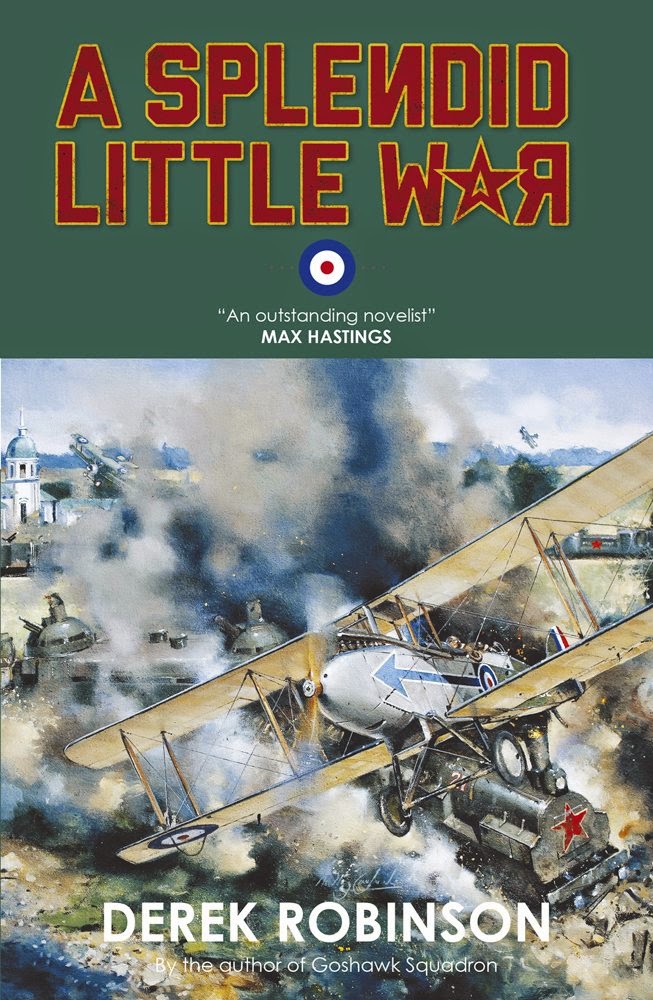
A Splendid Little War - Derek Robinson


The information presented was written by Chris Buckham; however, it was published in Soldier Magazine. Therefore, the material is reproduced here by the author with the permission of the magazine. If you would like to republish this information or refer to excerpts please contact the Assistant Editor Soldier Magazine (rclark@soldiermagazine.co.uk). Website for the Magazine is: http://www.army.mod.uk/soldier-magazine/soldier-magazine.aspx


Title: A Splendid Little War 
Author: Derek Robinson
Publisher: Quercus Publishing
ISBN: 9780857052322
Date: 2013
Pages: 316
Rating: 5/5

Mr Robinson has once again exceeded (already high) expectations and has produced another novel replete with tragi-comedy, education, cynical humour and action. Set in the midst of the Russian civil war, the book follows the experiences of Merlin Squadron, the RAF fighters sent to support the White Russian army in the southern steppe. Robinson is master of character development and he is able to capture the essence of the post war British Officer sent on yet another international escapade. A tight storyline woven into a historically accurate rendition of the conditions and folly under which the British airmen operated; this book cannot be recommended highly enough.

Tuesday, 17 September 2013

The Armored Bears Vol 2 - Veterans of the 3rd Panzer Division


Title: The Armored Bears Vol 2
Author: Veterans of the 3rd Panzer Division
ISBN: 978-0-8117-1171-5
Pages: 330
Hardcover
Photographs//Maps: 109 b/w//15
This book is the second of a two volume set translated from its original German on the history of the 3rd Panzer Division. Organized and originally published in 1967 by the veterans association of the unit, it was initially intended for members of the unit itself and their families as a testimony of their history and experiences. It covers the period from March, 1942 until August, 1945.

Continuing on from its first volume, Stackpole publishing has again reproduced another high quality English version of this book. The translation is, for the most part, very good. The maps are again mostly hand-drawn in their original German (which work well with the narrative). They have improved upon the utility of these maps quite noticeably in this second volume. The photographs are numerous and of a very high quality with many that I have not previously seen. This is where the benefit of drawing upon a veterans association really paid dividends. There are numerous fascinating anecdotes relating to the use of Cossack forces and camels by 3rd panzer forces in support of operations. The operational environment and breadth of employment history of the 3rd is really quite astounding and it is worth reviewing just to read about the adaptability of the personnel of this unit.

This work is an operational and tactical history of the unit so there is a great deal of detail regarding small engagements and individual achievements. I enjoyed this portion of the work because it provides the reader with a much more intimate view of the goings on and experiences of the soldiers. The narrative is replete with personal anecdotes from the rank and file that adds a fantastic degree of intimacy to the account. The appendices at the back of the book provide detailed synopsis of a rank table. Additionally, they provide lists of commanders, Knight’s Cross winners and recipients of the Army cross in Gold and Silver.

One of the unique and very positive aspects of the narrative translation are the numerous footnotes provided that serve to ensure accuracy and additional information to the reader. This is of particular benefit due to the fact that there are many references and comments that would be understood by a veteran of the unit but not necessarily by a casual reader. These footnotes serve to bridge that knowledge gap and they do so very effectively.

Overall, I think that this book is an outstanding compliment to volume 1 and would be a positive addition to any historian’s library or collection; having said that, it is again, very detailed and tactical in nature and therefore may not be for the more casual arm chair general. Regardless, Stackpole may be proud of this production as it is of a very high quality and is very readable. One can certainly appreciate the pride that this unit’s veterans had in their accomplishments and the role that they played in the Second World War. Strongly recommended.

Thursday, 12 September 2013

The Reconstruction of Warriors: Archibald McIndoe, The Royal Air Force and the Guinea Pig Club - Dr E.W.Mayhew


The information presented was written by Chris Buckham; however, it was published in Airforce magazine. Therefore, the material is proprietary to the Air Force Association of Canada and is reproduced here by the author with the permission of the association. If you would like to republish this information or refer to excerpts please contact the Editor Airforce magazine (editor@airforce.ca ). I support the Air Force Association’s important mission to inform new generations of Canadians about the value and importance of their country’s air force. A link to the AirForce Magazine website is: http://airforce.ca/magazine/

Title: The Reconstruction of Warriors: Archibald McIndoe, The Royal Air Force and the Guinea Pig Club
Author: E.R. Mayhew
ISBN: 9781848325845
Softcover
Pages: 239
Illustrations: 37 B/W
Publisher: Pen and Sword Publishing 2010

​This book speaks to two of the most diametrically opposed yet mutually supportive aspects of war: the ability to inflict horrific injury and the ability to heal. Mayhew has examined a secondary effect of warfare that had benefits far beyond the battlefield, that being the advances in the overall treatment of burns. Archibald McIndoe, a plastic surgeon assigned to the RAF in early 1939, and his staff, achieved almost legendary status amongst burned aircrew (the so called Guinea Pig club) for his successes. Through his force of personality he not only created a center of excellence for burn reconstruction but expanded his original mandate to meet the unanticipated flood of burn victims resulting from World War 2 aerial combat.

​During the interwar years there was very little need for burn reconstruction as the vast majority of patients died. Therefore, McInhoe had to develop his methodology from essentially ground zero. Based on his observations and a remarkable insight into the human condition, he initiated reforms ranging from patient care, ward placement and bed construction to post care engagement with the community. Mayhew’s narrative traces these innovations in such a way that the reader is able to both follow the changes and understand the reasoning behind the actions.

There is a distinct Canadian aspect to the story as Mayhew discusses the RCAF wing of McIndoe's hospital. Given the fact that the RCAF constituted the second largest group after the RAF, it was decided by the Canadian Government to fund a hospital to augment the RAF burn unit. The staff and organization were trained and outfitted in a manner identical to the RAF parent unit; of note was the fact that surgical and ward teams were made up exclusively of Canadian staff to a level of professionalism equal to that of McIndoe's. Such was its success and seamless integration within the RAF unit, that the head Canadian plastic surgeon, Group Captain Tilley, was appointed acting head of the entire organization when McIndoe went on convalescence leave in 1943.

Mayhew also expounds upon the unique dual approach that McIndoe initiated with the care and recovery of his patients; he recognized very early on the importance of reintegration and acceptance of his burn patients back into the society at large. To that end, he proactively engaged with the local town of East Grinstead as a means of his patients and civilians overcoming their fear of the unknown and each other. His holistic approach was very original and a smashing success. Such was its acceptance that the template was extended beyond England to Canada and its RCAF Guinea Pig Club members. McIndoe tirelessly engaged with Government at all levels, military staff and the medical community, knocking down preconceived notions of patient care and reintegration with great success. His actions went far beyond his primary role as a surgeon and set the standard for the modern health care provider.

McIndoe’s success was also a result of having likeminded individuals engaging in concert with him. The RAF, in a manner completely unique from the Army or RN, took and maintained complete responsibility for the burned crewmen. Thus they did not become wards of the Government but were maintained as part of the RAF family. The RAF leadership agreed with and completely supported the program recommendations of McIndoe. The influence and role of the Guinea Pigs carried on well past the Second World War and continues to this day. Those that benefited from it passed on their support to victims of the Falkland’s war and the Iraq conflicts.

Mayhew includes in her narrative an in depth bibliography and a reading/video list of timely and pertinent information on the success of the Guinea Pigs and their continued activities. Her writing style is very engaging and lucid. This book sheds light on an aspect of the war that populations don’t like to think about or be exposed to. Modern day techniques of treatment may be traced directly to the success and ground-breaking efforts of the original Guinea Pig Club and its members. Additionally, misrepresentations of the Guinea Pig membership are also rectified (such as the Club being made up almost exclusively of fighter pilots, as 80% of the patients were from bomber command).
 
Mayhew is to be complimented on an outstanding addition to expanding our knowledge of an area rarely discussed by historians. Her book should be mandatory reading for all defence members (both civilian and military) and on everyone’s history shelf. This book is most highly recommended.

Wednesday, 11 September 2013

The Armored Bears Vol 1 - Veterans of the 3rd Armored Division


Title: The Armored Bears Vol 1
Author: Veterans of the 3rd Panzer Division
ISBN: 978-0-8117-1170-8
Pages: 327
Hardcover
Photographs//Maps: 146 b/w//21


This book is the first of a two volume set translated from its original German on the history of the 3rd Panzer Division. Organized and originally published in 1967 by the veterans association of the unit, it was initially intended for members of the unit itself and their families as a testimony of their history and experiences. It covers the period from unit activation in 1935 until March, 1942.

Stackpole publishing has reproduced a high quality English version of this book. The translation is, for the most part, good; however, there are a number of instances where the sentences are awkward or run-on (suggesting perhaps a direct translation between German and English). This does not diminish the overall quality of the book but does give the reader pause. The maps are divided between those hand-drawn in their original German (which work well with the narrative) and those that are reproductions of original operations maps which are of little value as they are very busy, hard to follow and overly detailed. The photographs are excellent with many that I have not previously seen. This is where the benefit of drawing upon a veterans association really paid dividends. The book also contains graphs of the organization charts of the Division at different periods in its history. These are very beneficial and are accompanied by a very easy to follow template identifying what the symbols represent.

The narrative is clear except as indicated above. This work is an operational and tactical history of the unit so there is a great deal of detail regarding small engagements and individual achievements. I enjoyed this portion of the work because it provides the reader with a much more intimate view of the goings on and experiences of the soldiers. The narrative is replete with personal anecdotes from the rank and file that adds a fantastic degree of intimacy to the account. The appendices at the back of the book provide detailed synopsis’ of the equivalent ranks between American, Waffen-SS, English and German Armies. Additionally, they provide tables of commanders, Knight’s Cross winners and Army Honour Role recipients.

One of the unique and very positive aspects of the narrative translation are the numerous footnotes provided that serve to ensure accuracy and additional information to the reader. This is of particular benefit due to the fact that there are many references and comments that would be understood by a veteran of the unit but not necessarily by a casual reader. These footnotes serve to bridge that knowledge gap and they do so very effectively.

Overall, I think that this book would be a positive addition to any historian’s library or collection; having said that, it is very detailed and tactical in nature and therefore may not be for the more casual arm chair general. Regardless, Stackpole may be proud of this production as it is of a very high quality and is very readable. One can certainly appreciate the pride that this unit’s veterans had in their accomplishments and the role that they played in the Second World War. Recommended.

Cobra II - Gordon and Trainor

Title: Cobra II
Authors: Michael R. Gordon and Gen (Ret’d) Bernard E. Trainor
Publisher: Vintage
Date: 2007
Pages: 727
Photos/Maps: 35 b/w//18 
There have been many books written about the Iraq War from a myriad of angles. Cobra II is one of those that successfully peels back the layers from the macro to the micro, encompassing both the preplanning, invasion and immediate aftermath of the conflict. It is a balanced and critical evaluation of what the Americans did right and wrong in their planning and prosecution of this intervention. With commendable insight, the authors analyze the circumstances behind some of the more controversial decisions made by the participants including: what were the key influencers of Saddam Hussein’s decision making before the invasion and how were these actions interpreted in the West, what was the motivation of the US to re-engage in the Iraqi theatre,  how did the various key US agencies cooperate in setting policy and decision making, what impacted war-planning and how did the US military adjust and what were the key aspects of planning for post-war Iraq and were they successful? 
There is no question that the war has polarized US society and world opinion and has become the defining aspect of the Bush presidency. Many critics and supporters, with the benefit of hindsight, have offered up their interpretations of what was done correctly and incorrectly and whether or not the price was worth the investment. While every book is going to have elements of subjectivity, this narrative, in my opinion, provides information in such a way as to allow the reader to form their own opinions with the facts and events presented in an evenhanded manner. 
Following an in depth rendition of the timeline and key events of the lead up to and execution of the war, the authors provide an interesting and insightful analysis of some of the key lessons learned that they have gleaned from their research: 
1. A notable failure of the intelligence community to provide clear and accurate information and to not work together, both before and during the operation itself; specifically referring to agencies such as the CIA; 
2. A marked failure of key decision makers to work together  during the run-up to the war. Specifically, DoD, CIA, NSA and SecState did not cooperate and exercised (especially DoD) very compartmentalized information management;
3. A failure of the US Government, specifically DoD, to both appreciate and adequately prepare for the post war environment and to ignore indicators that ran contrary to their perceived ideas of how things would unfold; 
4. A marked lack of comprehension of the type of adversary that they would be facing (ie the asymmetric warfare of the jihadists and the Fedayeen) and a failure to adapt once they were engaged, and 
5. A diametrically opposite approach to the conflict between the civilian and military leaders within the DoD; Rumsfeld micromanaged the planning process with a view towards minimizing personnel and cost and relying upon technology. This was in direct contrast to the planning staffs of the US military and ignored the inputs of commanders who had significant experience in the region. This difference of opinion was never satisfactorily reconciled. 
The authors include as appendices a synopsis of acronyms very helpful to the narrative, reproductions of actual documents outlining attack orders, dissolving Iraqi military and paramilitary organizations at the direction of Paul Brenner and timelines/briefings provided to the President. All add significant breadth to the understanding of the actions of the book.
Another very interesting fact that is repeatedly identified is the impact of technology upon the unfolding battlespace. Much has been said regarding the overwhelming technical advantage that the Coalition forces had over the Iraqi's and indeed they did; however, the downside of said technology has rarely been mentioned. Such downsides included micromanagement from senior levels as they were able to watch in real time individual units and vehicles moving via "blue force tracker", an inability for US elements to speak to each other due to incompatible communication systems and an assumption that Iraqi forces would not be able to effectively counter US strategies (which proved to be false in the case of anti-air combat against US helicopters for example). 
Overall, Gordon and Trainor have produced a superb narrative and analysis of the initial years of the Iraq war. Future leaders would do well to read and learn the lessons identified in this book. That the West would win the war in Iraq was of little doubt; however, the planning fell far short of producing an effective strategy to deal with the dramatic changes that unfolded within the conflict zone as the war progressed. This book is very highly recommended.

Tuesday, 6 August 2013

Nimrod Rise and Fall - Tony Blackman

The information presented was written by Chris Buckham; however, it was published in Airforce magazine. Therefore, the material is proprietary to the Air Force Association of Canada and is reproduced here by the author with the permission of the association. If you would like to republish this information or refer to excerpts please contact the Editor Airforce magazine (editor@airforce.ca ). I support the Air Force Association’s important mission to inform new generations of Canadians about the value and importance of their country’s air force. A link to the AirForce Magazine website is: http://airforce.ca/magazine/
 
Title: Nimrod: Rise and Fall
Author: Tony Blackman
ISBN: 978-1-909166-02-8
Softcover
Pages: 223
Illustrations: multiple colour photos
Publisher: Grub Street Publishing

                The Nimrod Anti-Submarine Warfare (ASW) aircraft was a mainstay workhorse of the RAF for over 40 years before coming to a sudden and rather inglorious end in March, 2010. Blackman’s book traces the development and evolution of this aircraft as well as providing the reader with an in-depth review of the technical, doctrinal and operational details that were of a more delicate nature during its operational lifetime.

                The initial chapters deal with the history and development of the ASW program within the RAF, identifying the various unique aspects and technologies associated with sub-hunting. This includes the development of acoustics, passive and active sonobuoys and radar systems. He follows this with a detailed discussion of the Nimrod MR2 which was the primary configuration of the Nimrod for a majority of its operational life. His detailed description of the roles of the different flight stations, weapons systems, acoustical equipment and aircraft layout, all replete with photographs, are quite in depth and technical. ASW is a very complicated skill and the language is often steeped with acronyms and data that is completely foreign to the casual reader; Blackman assumes this and goes to great lengths to compensate for this.

                The follow-on chapters deal with the operational use of the Nimrod as an ASW platform, search and rescue (SAR) platform, long range patrol aircraft and intelligence gathering tool. The author takes full advantage of the plethora of experience available through past crew members and provides numerous first-hand accounts of missions; some harrowing, some humorous and all adding depth and scope for the reader. The versatility of the aircraft is clearly exemplified by renditions of the tracking and photographing of the Soviet carrier Kuznetsov and Flanker aircraft launching from it. Additionally, the Nimrod, with its vast range was ideally suited to be a SAR/patrol aircraft. This dovetailed very nicely with the fact that the Soviets had numerous intelligence gathering assets disguised as trawlers. The Nimrod would easily be able to transition roles from fisheries patrols to SAR to maritime security all within the same mission. Its excessive suite of communications and monitoring equipment made it an ideal command and control platform for a variety of circumstances.

                Blackman discusses in detail the events surrounding the Piper Alpha disaster from 1988 when an oil rig in the North Sea caught fire and became the focus of a major rescue operation involving a myriad of civilian air and sea units. Utilizing extensive firsthand accounts as well as general narrative, Blackman provides a comprehensive example of the versatility of the Nimrod as it coordinated the rescue operation on scene between the various onsite assets and the Rescue Coordination Centres. He follows this with a fascinating look at the involvement of the Nimrod in the Falkland’s war emphasizing the flexibility and utility of both the airframe (ie the ability to engage in air to air refueling) as well as the technology within it.

                The final two chapters deal in depth with major blows to the Nimrod and the resultant economic storm that ultimately caused the government to cancel the entire program. The first involved the attempted transition of the Nimrod from an ASW platform to an AEW (Airborne Early Warning) platform. Initiated in 1977 as a home-grown answer to a command and control platform deficiency; it witnessed the spending of hundreds of millions of pounds over a period of ten years before ultimately being declared a failure by the government and cancelled. Eleven aircraft were destroyed as a result. The final chapter brings to a close the story of the Nimrod. Faced with a significant domestic economic shortfall and an aircraft upgrade program (to the MR4 variant) that was heavily over budget and behind schedule; the British government made the decision in 2010, despite having crews trained, infrastructure in place and operational/upgraded aircraft being delivered, to not just cancel the program outright but to destroy the fleet itself. Blackman, a strong Nimrod supporter, is very critical of both the decision making process and how it was implemented.

                 Overall, this book is an interesting read relating the history of a storied aircraft. The narrative is quite dry and stilted in places, especially within the ‘Nimrod 101’ chapters where he relates the details of equipment, capabilities and crewing of the different variants of the Nimrod. Significant portions of these sections feel like it they are a reiteration of a basic technical manual. He does much better when relating the operational history and usage of the Nimrod within the Cold War and the Falkland Islands conflict. Production value of the book is high and the numerous photographs are a plus. This book is aimed more towards the aviation enthusiast as opposed to the casual reader of aviation history and will be quite enjoyed by that target audience.