Sunday, 18 January 2015

The Glass Cage - Nicholas Carr


Title: The Glass Cage                                                   
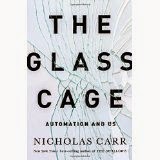
Author: Nicholas Carr   
ISBN: 978-0-393-24076-4
Publisher: Norton
Hardcover
Pages: 276
Photographs/Maps: 0 

There are two well known axioms that are often used to describe the human condition: "Knowledge is power" and "That which does not kill you, makes you stronger". Both seem, on the surface, to be both logical and unassailable; however, Carr's work, The Glass Cage, challenges the notion that the advancement of technology and its assumption of greater importance and a more central role in every facet of our lives, is making us stronger or more powerful as a society. 

Carr's central theme suggests that the advancement of automation in the world has not only made our lives easier in the sense that many of the mundane tasks that used to occupy our time are now accomplished by computers, but that it has also progressed to the point where the level of automation is no longer an enhancement of but a replacement for mankind. Human kind has now become a monitor/spectator to many of our daily activities.  

He draws upon a number of studies from a variety of disciplines that point to a gradual but marked decline in the capacity of humans to fend and think for themselves. Writing programs have autocorrect functions, shopping has targeted advertising, aircraft are automated such that pilots need only monitor, medicine has automated diagnostic systems, factories create systems that require little to no interface with human operators and gaming systems/communication technologies remove us further from actual face to face interaction. Carr acknowledges that, in and of themselves, these are not all negative advances and that there are practical benefits to be gained from applying technology. However, he suggests, given the gradual, insidious nature of the reliance that society has come to have on technology, that it has repercussions not only from an employment/societal perspective but also from a physical and psychological evaluation of who we are as humans. 

Carr presents that as we diminish our requirement to learn and, just as importantly, practise what we learn, our brains are undergoing physical change and, in some respects, atrophying; the same may be said for our ability to communicate and interact. These skills, like any, need to be used or they are lost. Carr backs up his assertions with practical examples and reference to numerous studies from the fields of medicine, ergonomics and psychology. 

He also, contends that the advent of technology as a replacement for the human in an equation is having the more subtle effect of raising the question of what is our role in the world. Are pilots still pilots if they are not physically flying the airplane and, as some may argue, they are no longer required in the cockpit at all? What is the role of a machinist if they are merely monitoring the equipment producing the good and what training and expertise do they really require?  

The West has become imbued with the idea that technology is a good thing and that there is little that it cannot do given time and development. While this may be true Carr advises that the computer works in the world of absolutes and has difficulty when faced with issues requiring subjective evaluation. He uses as an example the case where a driverless car must decide whether to hit a child who has run into the street or swerve into oncoming traffic thereby causing an accident that potentially kills its passengers. Additionally, the computer is only as good as the information and programming that goes into it. There are examples of technologies that are able to 'learn' and this will inevitably improve in the future but for now there are still some significant limitations on this ability. 

Why is all of this relevant to the leader of the future? I would contend that the further we remove ourselves from interaction with people and the practical world around us, the less capable we will be at dealing with situations and circumstances requiring decision making and those where the technological resources are not available. How well do we function today without smart phones and the internet? Technological development is not a bad thing but like anything it must be understood in the broader context of its impact. As a society we are driving forward without fully appreciating all of the ramifications of the tools that we have developed. Carr's book is a good read and presents a compelling argument for really asking ourselves what it is that we expect from technology and how do we, as humans, fit into that paradigm.

Thursday, 15 January 2015

At What Cost Sovereignty? - Dr Eric Lehre

This review was written by Chris Buckham and is published in the Canadian Naval review. Editor of the journal is Dr Ann Griffiths (Ann.Griffiths@Dal.Ca ). The website for the journal is: http://www.navalreview.ca/wpcontent/uploads/public/vol10num2/vol10num2book.pdf
 
Title: At What Cost Sovereignty?
Author: Dr Eric Lehre
ISBN: 978-1-896-44072-9
Publisher: Ctr/Foreign Policy Studies
Softcover
Pages: 405
 
Nation-states throughout history have made concerted efforts to define themselves in specific terms in order to ensure that they retain both a unique place within the international community and a common baseline within their nations from which to develop their culture. These efforts manifest themselves in many ways; military independence being one of them. However, as the cost of maintaining a military capable of standalone international operations has spun beyond the financial affordability for many states, coalitions and alliance-based operations and development have become the norm. With this evolution, the line between national independence and reliance has become progressively less clear.

Dr. Lerhe addresses this perception in his work looking at whether the advent of interoperability with the United States has or has not undermined Canada’s military and, by extension, national independence. The sensitivity most Canadians hold in this regard given Canada’s respective size and geographic location compared with the United States, makes this is a very relevant and timely topic of study.

There are several themes that permeate Lerhe’s work such as the traditional underlying suspicion of the military held by the Canadian media, intelligentsia and some Canadians, suspicion of the military’s relations with the government and civil society, and a willingness to perceive any action by the government as capitulating to diplomatic pressures from the United States. In this book, Lerhe examines a difficult subject because the discussion among Canadians on this topic is fraught with emotion and he challenges their perceptions with the facts as presented.

Lerhe commences his study with a look at a cross section of existing literature on what defines sovereignty (in itself a challenge). He then develops a matrix by which examples may be evaluated for their impact first upon internal and external levels of sovereignty and second by their impact within those two criteria. His method of evaluation, as much as possible, removes subjectivity from the equation and better allows for a factual, unbiased determination. Following an explanation of what the issue is and how he will approach it, he provides a comprehensive historical analysis of Canada’s military and governmental approach to interoperability from the turn of the 19 century to modern times. He then reviews the major works on the issues with a view towards establishing the breadth of academic, governmental and military opinion on the subject. In order to determine which (if any) of these views is correct he then evaluates a series of recent controversial issues surrounding the war in Afghanistan including: Canadian detainee policy; Canada’s decision relating to Operation Iraqi Freedom ; rejection from ISAF 2001-2002; Task Force 151; and Canada’s response to 9/11.
 
In each case, Lerhe presents the background to the subject, how it affected Canadian decision-making and how the issue was perceived in the Canadian media and intelligentsia. Once this baseline has been established, Lerhe undertakes a detailed analysis of senior Canadian government and military decision-making, and the expectations and actions of US senior governmental leadership and diplomatic staff. He also examines what was made available to the media and public at the time, and the international conventions (i.e., the Geneva Convention) against which the decision-making was taken. Finally, he reviews the understanding and comprehension of these issues by contemporary academia and the media in their analysis and presentation of the subjects. He utilizes extensive interviewing of the key players involved, detailed review of previously classified diplomatic communiqués from all parties, and legal analysis of what Canada’s international obligations entail. And finally, he examines these findings against the control measures that he defined earlier in his book to determine the impact on sovereignty (both internal and external). Lerhe’s work is balanced and fair. He makes a concerted effort to acknowledge those who hold differing perspectives and, rather than dismissing them out of hand, he incorporates their opinions with a view to upholding or disproving them. I found his analysis to be comprehensive and based in fact drawn from first-hand sources. Where he must draw conclusion from conflicting perceptions he readily acknowledges this and does his utmost to retain his impartiality.
 
At What Cost Sovereignty is a fascinating read and a laudable study into the challenges that not only interoperability presents but also how preconceived notions, biases and perceptions of media and academia can affect opinion and policy. It is a very readable and engaging book and one that media, historians, government policy-makers and senior military personnel should study.

Sunday, 11 January 2015

The Siege of Brest 1941 - Rostislav Aliev

This review was written by Chris Buckham and is published in the Canadian Army Journal. Editor of the journal is Maj Chris Young (CHRISTOPHER.YOUNG8@forces.gc.ca). The website for the journal is http://www.army-armee.forces.gc.ca/en/canadian-army-journal/army-journal-14-3.page.

Title: The Siege of Brest 1941
Author: Rostislav Aliev
ISBN: 978-1-78159-08-0
Publisher: Pen and Sword
Hardcover
Pages: 219
Photographs/Maps: 45/5

The battle for the fortress of Brest commenced immediately upon the attack by the Germans on the Soviet Union, 22 June, 1941. Located upon a strategic line of advance, it was the focus and task of the German 45th Infantry Division to capture it within the first 24 hours. To accomplish this feat, a heavy concentration of artillery including two massive 600cm siege mortars, were employed to reduce both the fortress and the garrison. However, despite achieving complete surprise on the garrison, steadfast leadership and dogged determination on the part of the Soviet survivors resulted in a brutal battle of attrition that lasted for seven days before the final contingent of Soviets surrendered (individual soldiers continued to fight until as late as August, 1941).

Aliev's most noteworthy achievement with this work lies not with the depth of detail or the lucidity of the text but in the fact that he has superbly rendered the story of the lead up and execution of the battle with a degree of suspense and drama rarely achieved in historical narrative. His humanization of key Russian and German figures adds life and dimension to this trial by combat.

By switching his storyline between the opposing sides, thereby creating concurrent lines of narrative, he gives the reader a clear vision of the perspective, stresses and decision influencers of each. One truly begins to appreciate the horror of the conditions under which the Russians fought and the cold blooded realities facing those wounded or captured by either side. Interspersed with these were instances of true humanity as Germans, while frustrated at the continued intransigence of the Russians, nevertheless came to see their opponents as warriors worthy of respect. Aliev is able to convey with startling clarity the responsibility assumed by the most junior of Russian offiers, a real sense of the brutality of the hand to hand fighting, the fear of close quarter combat with knives and grenades in the confined spaces of the fortress casemates and the suffering of the wounded and civilians trapped within the fortress.

The major critical observations on this book centre upon two points: there is no index nor a bibliography which is always important for reference at a later date and the fact that, while there are excellent maps tracing the unfolding combat, there is not a map that provides a single overview of the fortress itself. It would have been quite useful to have had a single reference for the layout. 

Aliev, for his part, does refer to sources that he used in his introduction (German Bundeswehr archives in Freiburg and Soviet recollections gathered in the 1950's by Sergei Smirnov's as well as the report by the commander of the 45th Infantry Div "Account of the taking of Brest-Litovsk"). By doing so, he is able to compare and confirm the recollections and timelines using sources from the opposing camps.

The efforts, names and valour of the warriors of Brest-Litovsk were unknown to the Soviet leadership for a long time and, it was not until the late 1950's that excavations of the fort recovered the final remains of many who had held out long after all hope had expired. For the Russians, Brest served as a shining example of courage and fidelity during a period of great loss and collapse. 
 
Stuart Britton undertook the translation of the original Russian transcript and has done a remarkable job of not only reproducing the work into english but also ensuring that the 'essence' of the narrative conveyed in the original work was maintained. The book is an excellent rendition of a little known battle that was literally a footnote in the massive campaign that was Barbarossa or the Great Patriotic War.  It serves as an excellent example of the effect that inspired leadership at the lowest level can have on the outcome of a battle. Aliev, has ensured through his efforts that the valour and sacrifice of both the defenders and the aggressors will not be forgotten.

Saturday, 27 December 2014

Barbarossa Through Soviet Eyes: The First 24 Hours - Artem Drabkin, Alexei Isaev


Title: Barbarossa Through Soviet Eyes: The First 24 Hours                                      
Author: Artem Drabkin, Alexei Isaev
ISBN: 978-1-84415-923-9
Publisher: Pen and Sword
Hardcover
Pages: 186
Photographs//maps: 129 b/w//3                                                         

22 June, 1941 is easily a day as important in the history of the Russian/Soviet peoples as Pearl Harbour is to the United States. Their societies were shocked, in disbelief, angry, resentful and in many cases pleased that the Germans had invaded.  What is oftentimes missing is a record of the reaction, the human face if you will, of the Soviet people as the German juggernaut swept over them. This is due to many things but mainly because of the closed and controlled nature of the Soviet Union post World War 2 and its reluctance to reveal anything that may be perceived as weakness. Thus a majority of the Eastern Front histories have been written and interpreted from a German perspective. This book represents an effort to rectify that imbalance and to add the voice of the Soviet soldier and civilian to the discussion.

Books originally in Russian sometimes lose a portion of their focus in translation and also are often in a style quite unique from traditional English writings; Drabkin’s book is no exception to this. The narrative is good but at times appears to flow off in directions that cause the reader to pause. Additionally, there are a significant number of instances where the author neglects to explain his point or perspective in adequate detail thus leaving the reader to wonder what was the intent.

Having said this however; there is much to compliment this book. Drabkin identifies early on that he initiated the book as a repository of the recollections of the generation that fought in the Great Patriotic War and he draws a great deal from the website ‘iremember.ru’ which he created as a central spot for veterans to have their stories preserved. While the book is quite short relative to the subject, he does give adequate balance to all of the elements, the rear echelon and the home front, in outlining experiences and recollections. He also spends a good deal of time on those aspects of the invasion that have received little to no coverage in contemporary history, specifically the actions of the Soviet navy in the Baltic and Black Sea.

Drabkin’s subjects range in age and responsibility (from, for example, children in the smallest villages far from the front to those with access to the inner sanctum of Stalin’s office) and it is very interesting to view the different perspectives and perceptions of that day. One is struck by the reliance people had on government radio and local newspapers for information, the confusion of the initial commands regarding response postures, the striking lack of initiative on the part of a significant number of commanders, and, in contrast, the bravery shown many who did assume the risk of independent response. It is also fascinating both the degree of shock and surprise felt by the Soviet people at being attacked by the Germans and the number of instances where Soviet soldiers were spontaneously attacked or impeded by Ukrainian, Polish, Baltic and other occupied peoples as they struggled to organize a response.

The book is a relatively quick read and, while it provides a strategic and operational context within which the recollections occur, there are better histories of Operation Barbarossa available for those seeking this information. Where it becomes much more worthwhile is the human face that it puts on the Soviet side of the conflict. Pen and Sword have published, as per, a quality book and the sources provided are a good lead for those looking at the Soviet side of the war.

Wednesday, 17 December 2014

Battle for the Baltic Islands 1917 - Gary Staff

This review was written by Chris Buckham but published by Sabretache magazine. The website for the magazine is: http://www.mhsa.org.au/journal.htmland the editor is Mr Paul Skrebels editor@mhsa.org.au.
 
Title: Battle for the Baltic Islands 1917
Author: Gary Staff
ISBN: 978-1-84415-7877
Publisher: Pen and Sword
Hardcover
Pages: 178
Photographs/Maps: 47 b/w//15

Conventional knowledge regarding naval operations in the First World War tends to be limited to the Battle of Jutland and perhaps the Battle of the Falkland Islands. Additionally, they are traditionally focussed almost exclusively upon engagements between the British and the German capital fleets; Russian, French, Austro-Hungarian and Italian fleet operations have generally been forgotten. Furthermore, the casual history buff will know only that the German High Seas fleet did not have another major engagement with the British following Jutland, rebelled at the end of the war and was scuttled after being interred at Scapa Flow. This is one of the main attractions of Staff’s book, the fact that it sheds light on a heretofore little known, yet critical, joint German engagement that had a fundamental impact upon the course of the war.

The German Fleet was, in fact, quite busy with operations in the Baltic against the naval forces of the Czar. This book centres upon the largest of these engagements, the Baltic Islands. Why this battle was undertaken involved both operational and strategic considerations on the part of the German Empire. Germany desperately needed to free up forces from the eastern front and the Russians continued to fight despite the Russian revolution which toppled the Czar and destabilized the country; Germany needed to deliver a blow that would quickly bring ‘whomever’ on the Russian side to surrender talks. The Baltic Islands were key to this as they controlled access to the Gulf of Finland which, in turn, controlled the approaches to St Petersburg, the Russian capital.

One of the most fascinating aspects of this battle was the jointness of the operation (led by the German navy under the command of Vizeadmiral Ehrhard Schmidt) on the German side. Planning involved the landing of naval as well as regular army forces (at Regimental and Divisional strength), supported by aircraft and zeppelin assets. The complexity of the planning, the cooperation between the elements and the critical success of the operation itself is testament to the capabilities of the German leadership. Another facet was the impact of the revolution on the effectiveness of the Russian forces. Soldier’s/sailor’s councils acted to consistently challenge and undermine the command and control of the Russian Commanders (as they had to convince as much as order in many cases). Regardless, they were still very well led by the overall Russian fleet commander, Vice-Admiral MK Bakhirev; there was a great deal of fight left in the Russians as they too realized the importance of these islands.
 
Staff’s writing style is very engaging and his analysis thorough and comprehensive. He presents a very balanced view of both of the protagonists in terms of tactics, personalities and strategic interests. Additionally, he draws attention to a number of interesting facets of the engagement that serve as a foreshadow of things to come: the fact that despite the confusion of the Russian Revolution, the Czar’s Intelligence service continued to function almost unaffected and the German Air Force undertook a series of successful air raids on not only land positions but also naval targets. The end of the book contains a series of appendices that explain the technical capabilities of the naval forces engaged, their command structures and a timeline of the battle; excellent for quick reference. Finally, much of the narrative is drawn from first hand recollections and sources of individuals present at the situations described. The author has made very good use of these, weaving the accounts seamlessly into the broader storyline.
 
Overall, I strongly recommend this book for its high production value, fascinating history and the strength of the writing and research of the author. The role that the German Fleet played in the war has been diminished and greatly overshadowed by events elsewhere and its utility as an effective arm of German foreign policy largely lost; Staff’s book sheds light on a successful fleet  engagement that had a fundamental impact upon the course of the war and resonated far beyond the islands that it was fought over.

Sunday, 7 December 2014

The Lieutenant Don’t Know - Jeff Clement

Title: The Lieutenant Don’t Know
Author: Jeff Clement
ISBN: 978-1-61200-248-4
Publisher: Casemate
Hardcover
Pages: 264
Photographs/Maps: 46/2
 
The author has drafted a very readable account of his training and deployment as a Lieutenant in charge of 2nd Platoon, Combat Logistics Battalion 6 in Afghanistan during 2010. He focusses a great deal upon the warrior ethos of the Marines and the flexibility with which they are employed. His observations on tactical leadership and planning are insightful and backed up through personal experience and examples. I enjoyed his obvious enthusiasm, candor and honesty; his tale is one of personal growth as a leader and the successes and failures that he met while enroute. This is a very informative and worthwhile book for a junior officer.

Friday, 5 December 2014

Organisation Todt: From Autobahns to the Atlantic Wall - John Christopher


Title: Organisation Todt: From Autobahns to the Atlantic Wall
Author: John Christopher
ISBN: 978-1-4456-3856-0
Publisher: Amberley
Softcover
Pages: 255
Photographs/Maps: 71b/w//38 colour//5
Rating: 3.5/5

Christopher has reproduced an edited version of an intelligence report produced in March, 1945 for the benefit of Allied commanders. Organization Todt (OT) was the construction engineering arm of the German Government charged with both the planning and execution of all major construction projects throughout the Reich; at its height it comprised over 1.5 million personnel. It was an extremely effective organization, undertaking, in five years, the largest building program since the Roman Empire. The book is an outstanding reference for this institution but it is very dry in its presentation; nevertheless, a fascinating study of a little known but critical aspect of the Reich.